
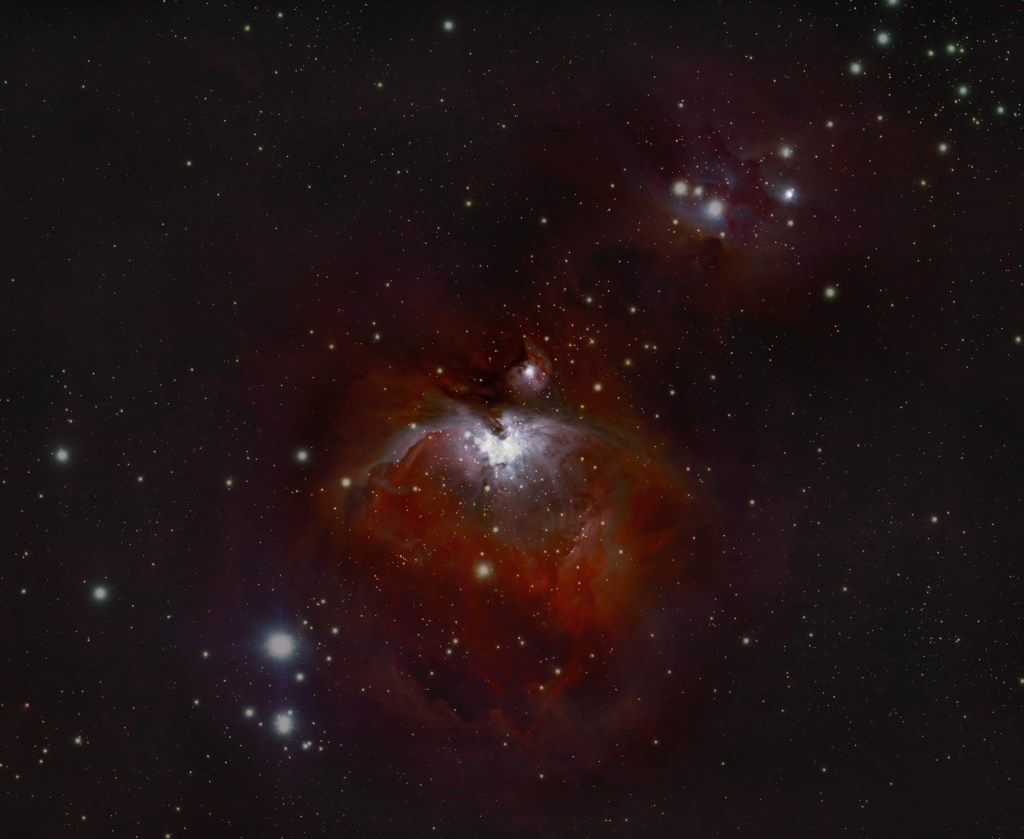
The Orion Nebula is also known as Messier 42 or M42. It is a dazzling cloud of gas and dust in the constellation Orion. It is one of the brightest nebulae in the night sky, visible to the naked eye even from light-polluted areas.
The Orion Nebula is a stellar nursery, where new stars are born from the collapsing clouds of gas and dust. The nebula is home to a cluster of young, hot stars. This cluster, known as the Trapezium, illuminates the nebula. It also shapes its wispy tendrils.
The Orion Nebula is a popular target for astronomers and astrophotographers. It has been studied extensively, and its secrets are slowly being unraveled. The nebula is a fascinating place. Stars are born there. Planets form, and the forces of nature play out on a grand scale.
Distance and size
The Orion Nebula is located about 1,350 light-years from Earth. It is about 24 light-years across, which is roughly the same size as 200 solar systems!
What can you see in the Orion Nebula?
With the naked eye, the Orion Nebula appears as a fuzzy patch of light. However, with a telescope, you can see much more detail. You can see the four bright stars of the Trapezium. You can also observe the nebula’s swirling clouds of gas and dust. You can also see newborn stars, planetary disks, and even protoplanetary jets.

This image was captured with 2 hours of exposure through a Dual Band filter on a one shot color camera.
Following image is exactly the same data but processed differently to make a wider field image that is not cropped
SVBony 80mm f6 480mm f/l triplet reflector
SVBony Dual Band filter and filter draw

The Orion Nebula is a beautiful and fascinating object that has captured the imagination of humans for centuries. It is a reminder of the vastness and wonder of the universe.
I hope you enjoyed this short blog about the Orion Nebula. If you have any questions, please feel free to leave a comment below.
Additional facts about the Orion Nebula:
- The Orion Nebula is about 2 million years old.
- The nebula contains about 2,000 times the mass of the Sun.
- The nebula is home to hundreds of young stars, as well as many newborn stars and planetary disks.
- The Orion Nebula is a UNESCO World Heritage Site.
I hope this blog has given you a better understanding of the Orion Nebula. If you have any questions, please feel free to ask!
Discover more from Nicks Astrophotography
Subscribe to get the latest posts sent to your email.
 Nicks Astrophotography
One thought on “Capturing The Orion Nebula: A Starry Jewel in the Night Sky”