
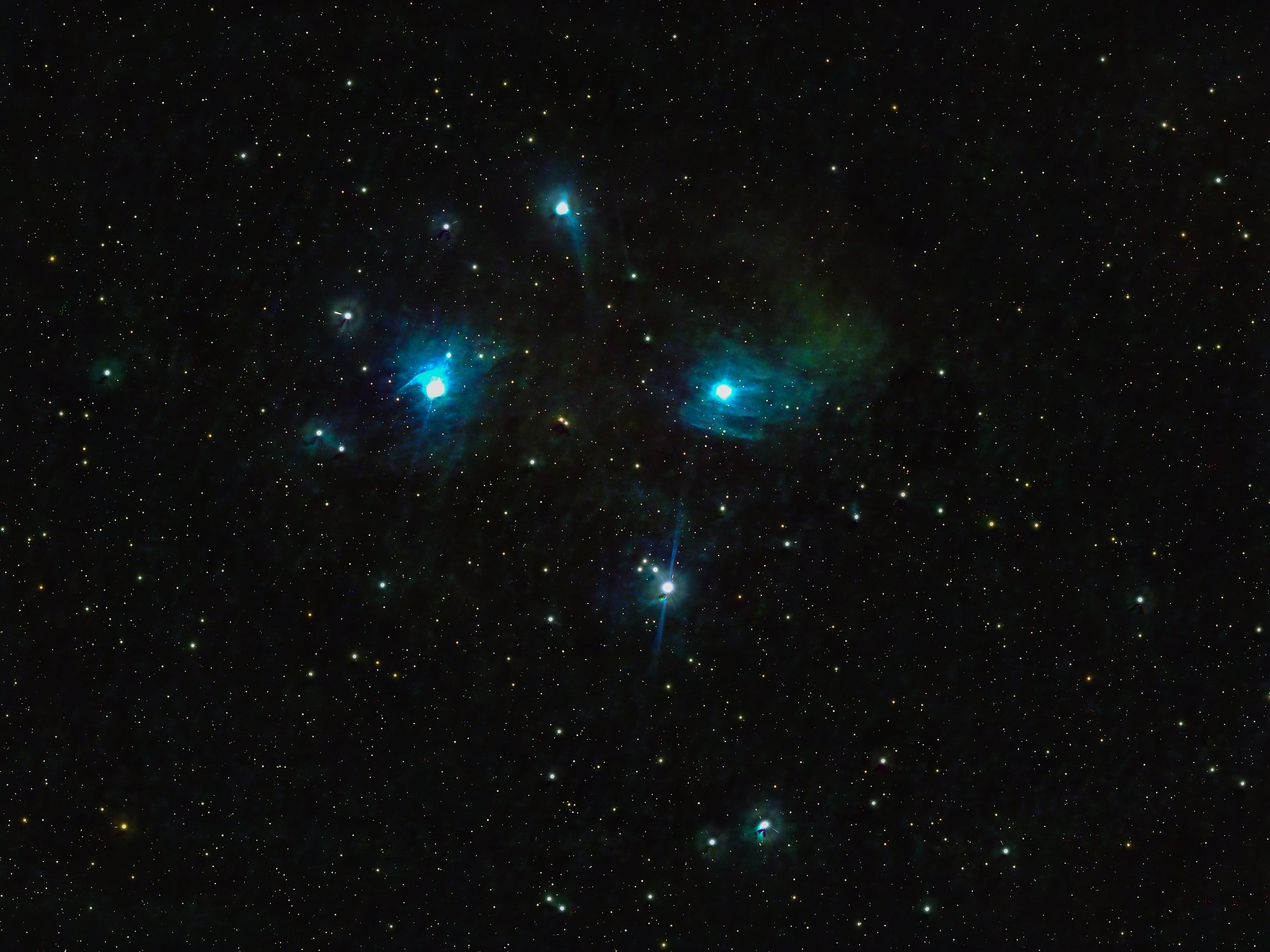
The Pleiades, also known as the Seven Sisters or Messier 45, is an open star cluster located in the constellation Taurus. It is one of the most recognizable star clusters in the night sky, visible to the naked eye as a group of six or seven bright stars. The Pleiades is about 444 light-years away from Earth and contains hundreds of stars, most of which are young and hot blue giants.
The Pleiades has been a source of fascination for humans for centuries. It has been mentioned in myths and legends from cultures around the world, and it is still considered a sacred place by many indigenous people.

What makes the Pleiades so special?
There are several things that make the Pleiades so special. First, it is one of the youngest open star clusters in the Milky Way galaxy, only about 100 million years old. This means that the stars in the Pleiades are still forming, and they are surrounded by large clouds of gas and dust. These clouds are responsible for the beautiful nebulosity that can be seen around the stars in the Pleiades.
Second, the Pleiades is home to a large number of brown dwarfs. Brown dwarfs are objects that are too small and cool to be classified as stars, but too large and hot to be classified as planets. The discovery of brown dwarfs in the Pleiades has helped us to better understand how stars and planets form.
Finally, the Pleiades is a relatively close star cluster, which makes it a good target for astronomers. Astronomers have been studying the Pleiades for many years, and they have learned a great deal about star formation, stellar evolution, and the interstellar medium.
The Pleiades in mythology
The Pleiades has been mentioned in myths and legends from cultures around the world. In Greek mythology, the Pleiades were seven sisters who were pursued by the hunter Orion. The sisters eventually escaped Orion by being turned into stars. In Maori mythology, the Pleiades are known as Matariki, and they are associated with the beginning of the new year.
The Pleiades today
The Pleiades is still a source of fascination for scientists and stargazers alike. Astronomers are continuing to study the Pleiades to learn more about star formation, stellar evolution, and the interstellar medium. Stargazers can enjoy the beauty of the Pleiades with the naked eye or with a telescope.
Image captured with :-
SVBony 80mm triplet refractor f6 480mm focal length
SVBony SVC405cc one Shot Color Camera
SVBony 705c Guide camera
ZWI AM5 Tracking Mount
SVBony UV/IR Cut filter
60x 60 second exposure – Gain 110 – CCD Temp -5°C
10x darks and 10x flats
Discover more from Nicks Astrophotography
Subscribe to get the latest posts sent to your email.
 Nicks Astrophotography
2 thoughts on “Pleiades – 25th January 2024”