
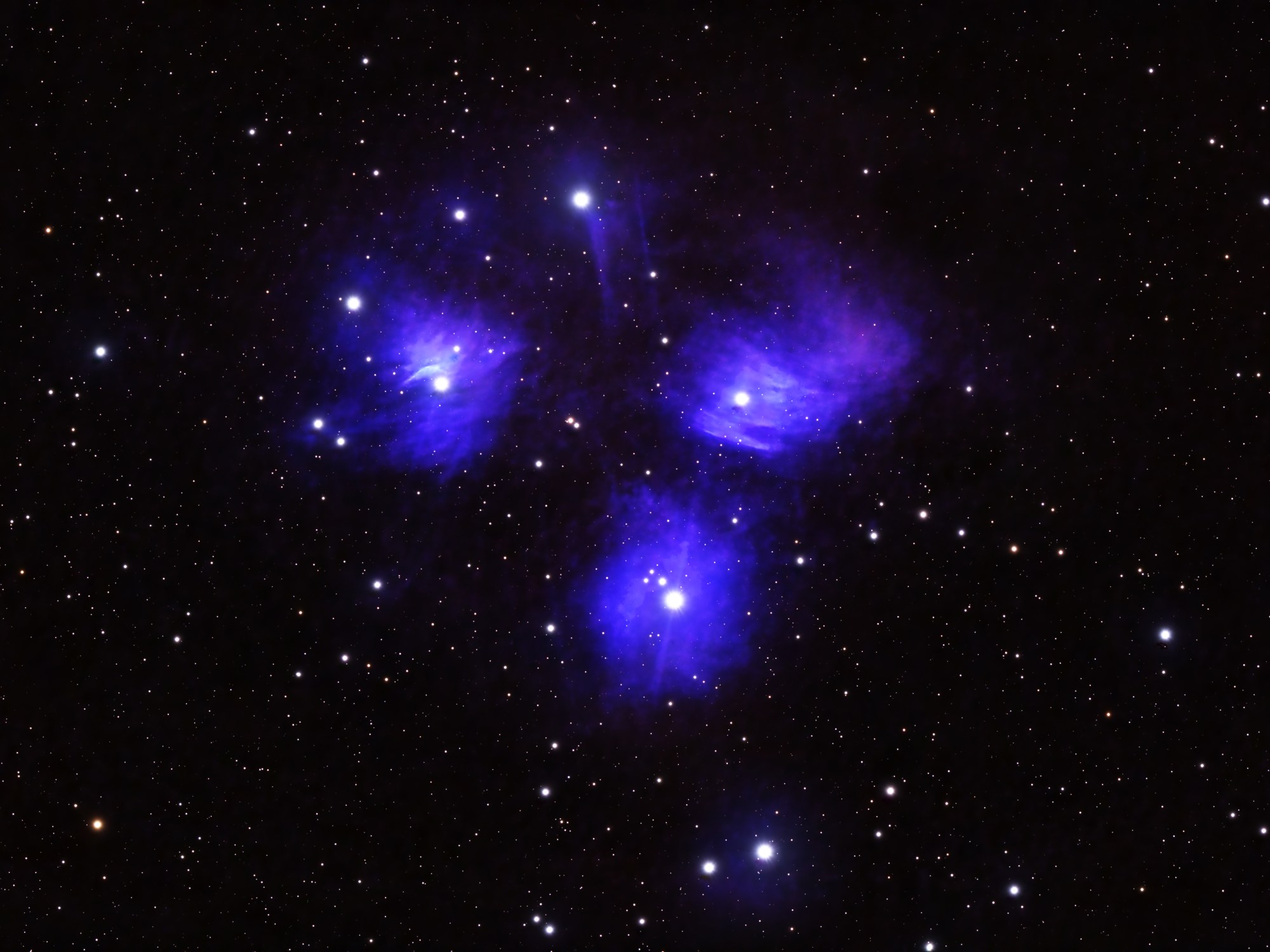
Gazing up at the night sky, have you ever noticed a tiny cluster of stars sparkling brightly, almost as if they huddled together for warmth? If so, you’ve likely encountered the Pleiades, a breathtaking open star cluster also known as the Seven Sisters or Messier 45.
For centuries, these celestial siblings have captivated humanity, inspiring myths, legends, and cultural narratives across diverse civilizations. The Pleiades hold a special place in many cultures, often associated with fertility, rebirth, and celestial navigation.
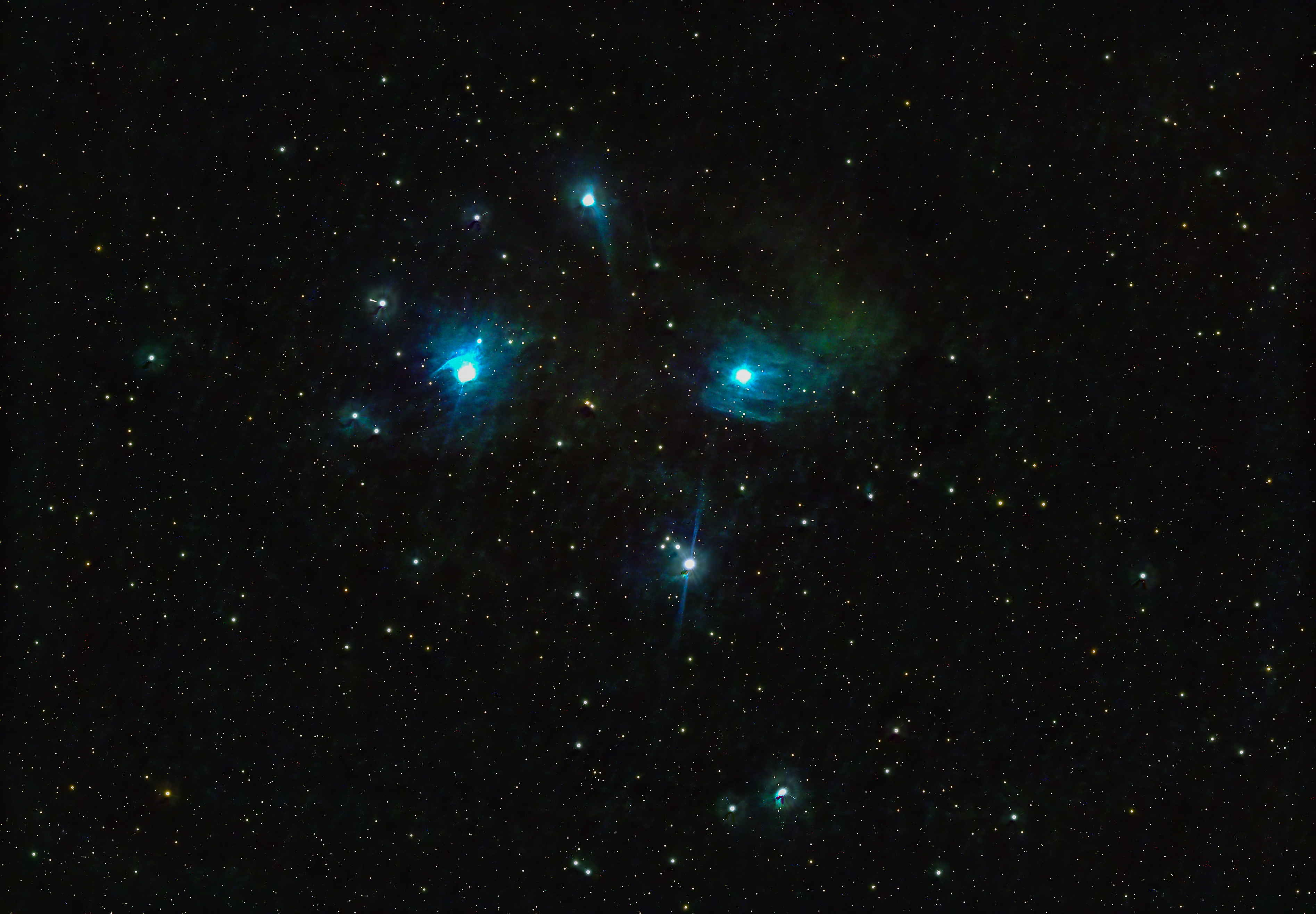
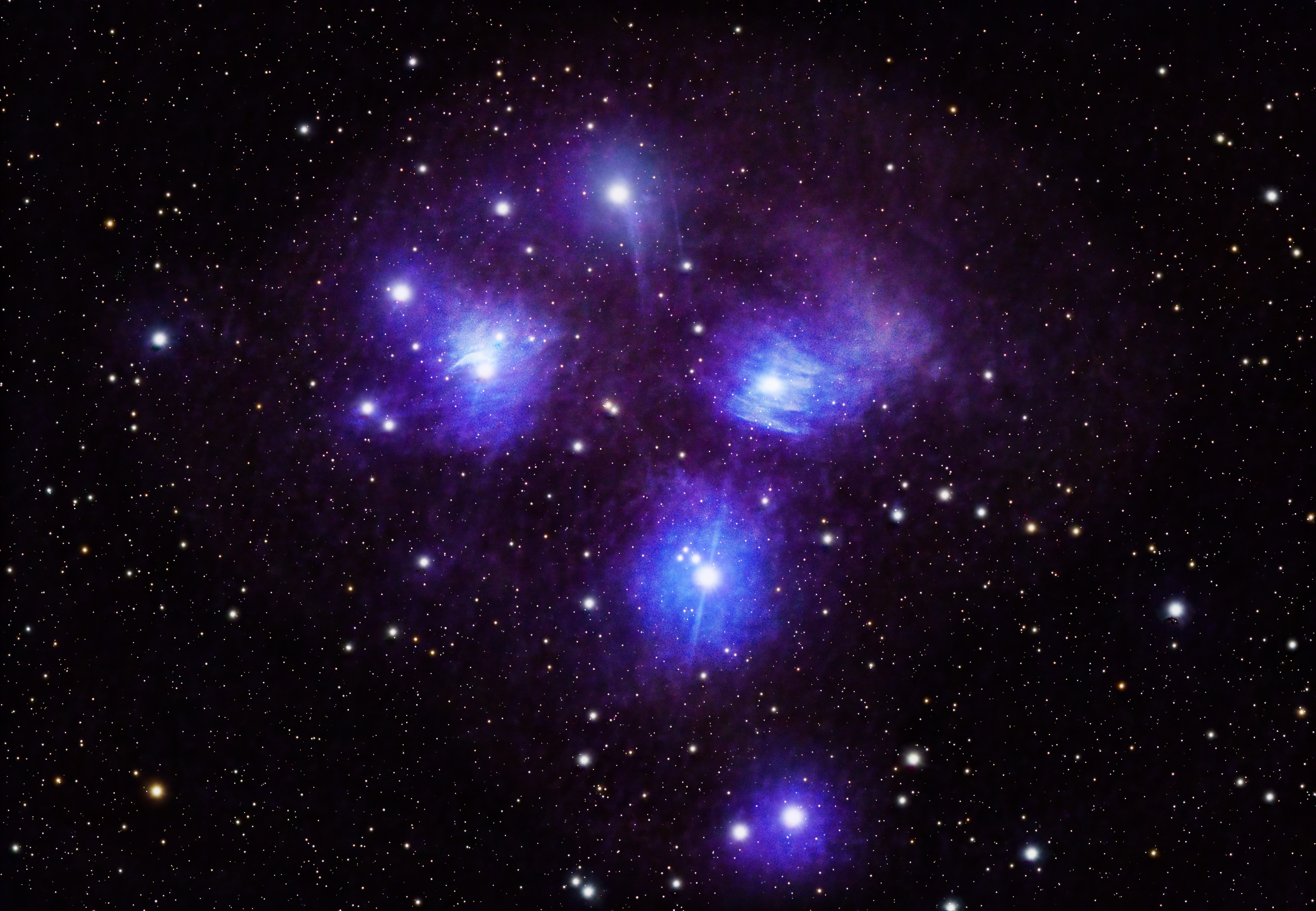
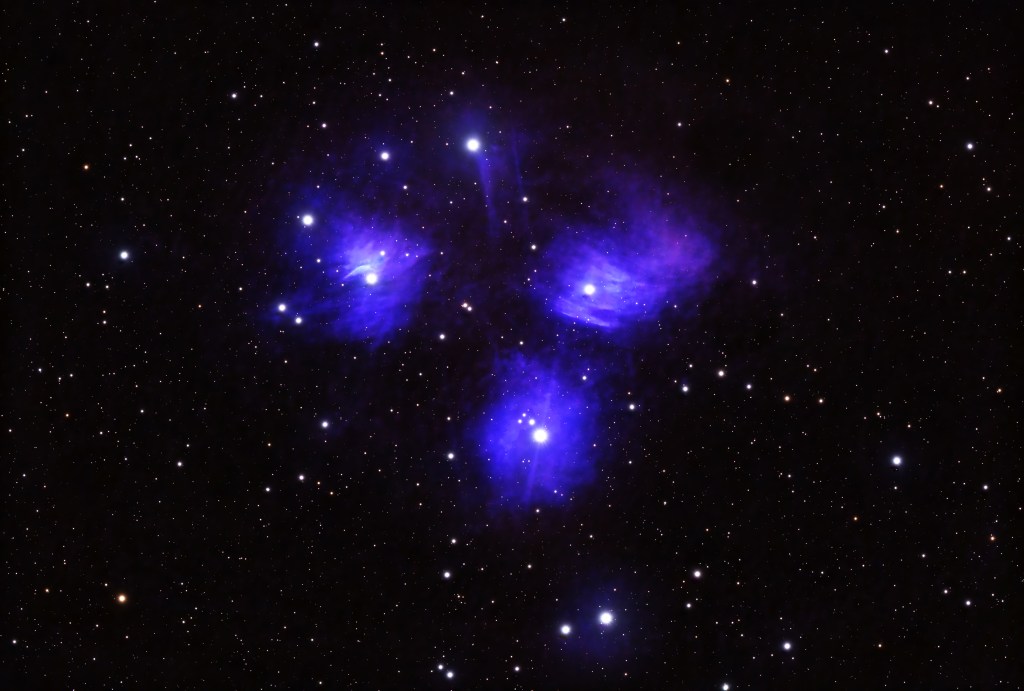
I began the Pleiades imaging project on January 25th 2024. My plan was to collect 3-4 hours of data on this subject. The Pleiades star cluster is pretty easy to find, and actually can be imaged in just a few relatively short exposures if you only want to capture the stars. However, the beauty of this cluster lies in not only the pattern of the brightest stars, the 7 sisters, but in the faint nebulosity surrounding them. To bring out this detail you need longer exposures, but at the risk of blowing out and over exposing the bright stars. Pleiades is a great target for beginners, and allows you to practice those valuable post processing skills that bring out the beauty of the deep space objects we are trying to capture.
A Stellar Family Portrait
Located roughly 444 light-years away in the constellation Taurus, the Pleiades boast around 800 identified stars, though only seven are readily visible to the naked eye under ideal viewing conditions. These seven brightest members – Alcyone, Atlas, Pleione, Maia, Taygeta, Electra, and Merope – form the asterism that grants the cluster its nickname.
However, the Pleiades aren’t just a pretty face. They are young stars, estimated to be only around 125 million years old, compared to our Sun’s 4.6 billion years. Their youthful nature is evident in their intense blue-white glow, fueled by ongoing nuclear fusion reactions in their cores.
A Cradle of Stellar Creation
The Pleiades are also an active stellar nursery, brimming with gas and dust clouds where new stars are born. In fact, the cluster itself is thought to have originated from a giant molecular cloud millions of years ago. This ongoing cycle of birth and death makes the Pleiades a valuable natural laboratory for astronomers studying star formation and evolution.
Beyond the Seven Sisters
While the seven brightest stars dominate the visual spectacle, the Pleiades harbor a wealth of hidden treasures. Nebulae, wispy clouds of gas and dust, shroud some of the cluster’s members, hinting at the ongoing stellar formation processes. Additionally, astronomers have discovered numerous brown dwarfs, “failed stars” too faint to ignite sustained nuclear fusion, lurking within the cluster.
Unearthing Celestial Secrets
The Pleiades continue to enthrall astronomers and skywatchers alike. Advanced telescopes are peering deeper into the cluster, unraveling its intricate structure and uncovering new members. By studying the Pleiades, we gain a deeper understanding of our own place in the vast cosmic tapestry, learning about the birth and death of stars, and perhaps even the origins of our own solar system.
So, the next time you gaze upon the night sky, take a moment to appreciate the Pleiades. These celestial sisters offer a glimpse into the heart of stellar creation, reminding us of the interconnectedness of everything in the universe.
Discover more from Nicks Astrophotography
Subscribe to get the latest posts sent to your email.
 Nicks Astrophotography