
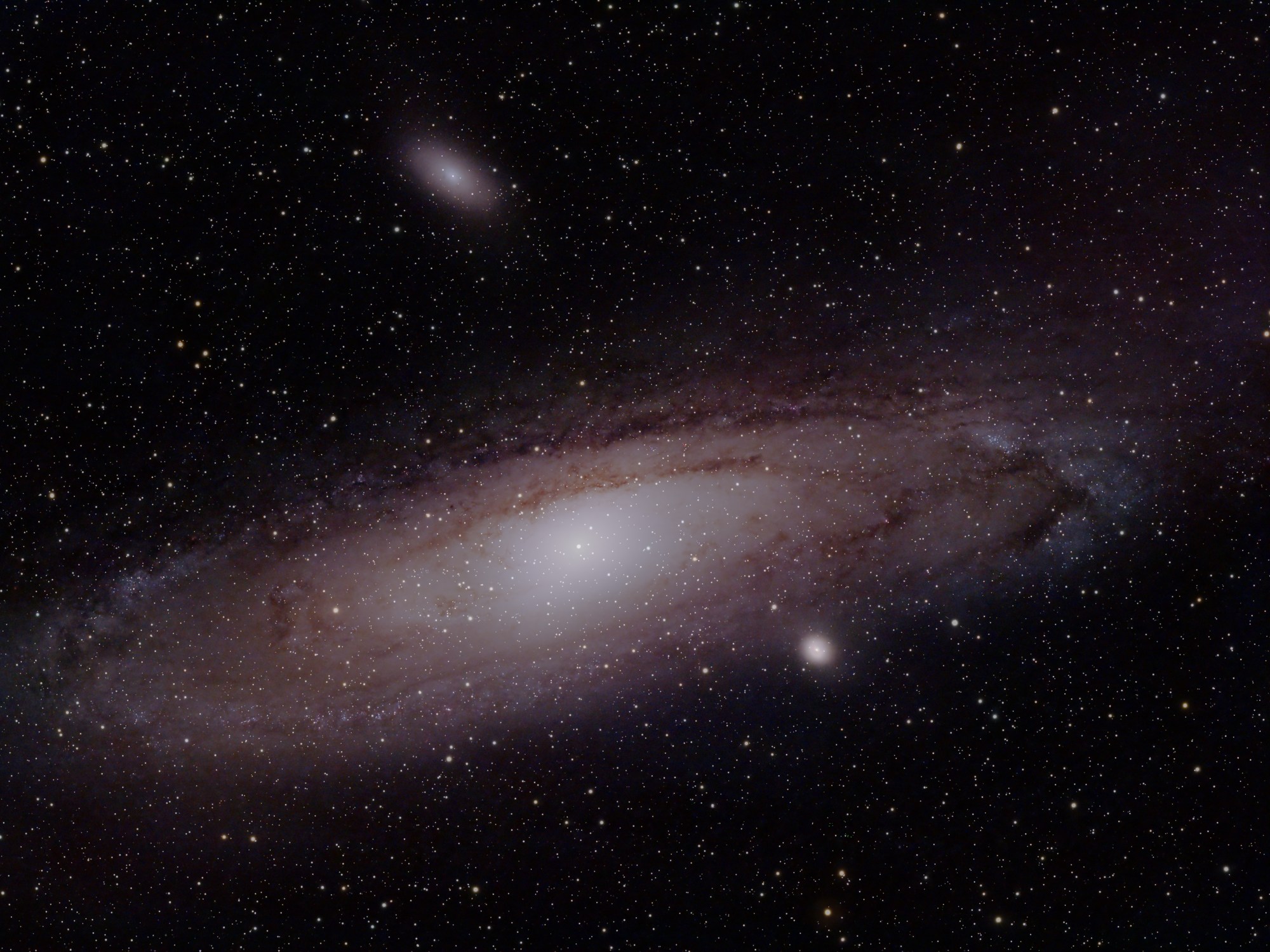
Ever gazed up at the Milky Way and wondered if there were other galaxies out there? Look no further than the Andromeda Galaxy, our closest galactic neighbor, a mere 2.5 million light-years away!
This image of the Andromeda Galaxy was captured with an 80mm aperture triplet refractor scope at f6 gives 480mm focal length. A total of 2 hours of images with 120 second exposures with SVBony 405cc color one shot astro cooled camera. A UV/IR cut filter was employed to help reduce star bloating.
Processed with Pixinisight and Photoshop.

A Galactic Twin
Andromeda, also known as Messier 31, is a spiral galaxy similar to our own Milky Way. Both boast swirling arms, a central bulge, and billions of stars twinkling within. In fact, with an estimated trillion stars, Andromeda slightly outshines our own galaxy!
A Journey Through Time
Gazing at Andromeda is like peering back in time. The light we see today left the galaxy 2.5 million years ago, meaning we’re witnessing a snapshot of its past. Imagine the civilizations that might have risen and fallen during those eons, unknown and unseen!
A Collision Course?
Hold onto your spaceships, space fans! Andromeda and the Milky Way are on a collision course. In about 4.5 billion years, the two galaxies will merge in a spectacular galactic waltz, creating a behemoth known as “Milkomeda.” While it sounds apocalyptic, the chances of individual stars colliding are actually quite low. So, rest assured, you’ll have plenty of time to enjoy the show!
Unraveling the Mysteries
Andromeda continues to be a source of fascination for astronomers. We’re still learning about its structure, star formation, and the possibility of harboring planets. Powerful telescopes like the Hubble and James Webb are peering deep into its core, searching for clues about its past and potential future.
Next Time You Look Up…
The next time you stand under a clear night sky, take a moment to appreciate the Andromeda Galaxy, a cosmic mirror reflecting our own Milky Way. It’s a reminder of the vastness and beauty of the universe, and the incredible journey we’re all on together.
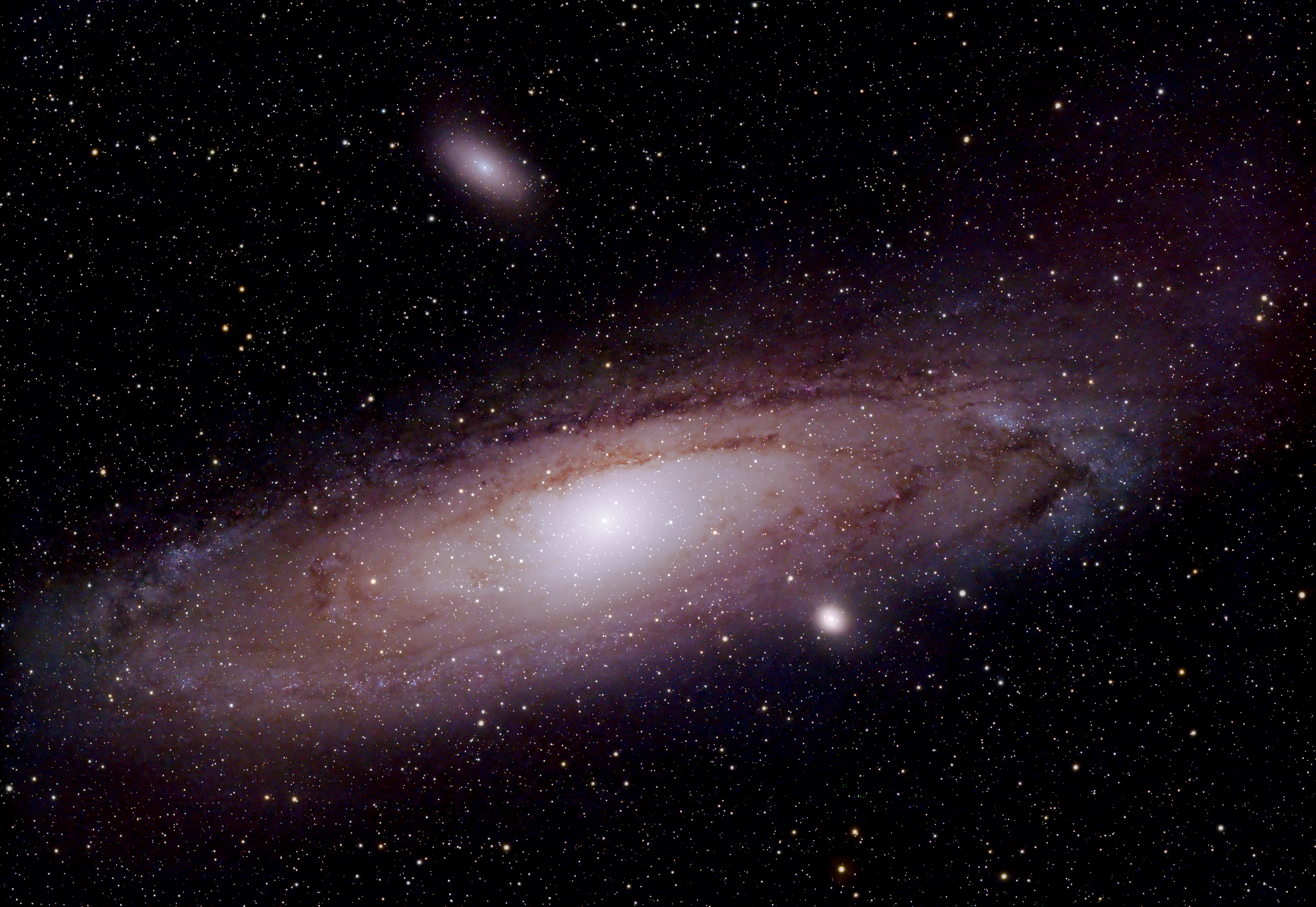
The above image is a total of 4 hours exposure, 2 hours 120 second exposures, 2 hours 180 second exposures. Stacked in deep sky stacker and edited in Pixinsight and Photoshop.
The additional 2 hours brings out more detail and color in the eliptical disk.
Discover more from Nicks Astrophotography
Subscribe to get the latest posts sent to your email.
 Nicks Astrophotography