
Astrophotography isn’t just about pointing your camera at the stars and hitting the shutter button. It’s about capturing the faint whispers of light from distant celestial objects, and that’s where integration time steps in as the hero of the show.
What is integration time?
Simply put, it’s the amount of time your camera sensor is exposed to light during a single image. In everyday photography, integration time might be a fraction of a second, but in astrophotography, it can stretch to minutes, hours, or even days!
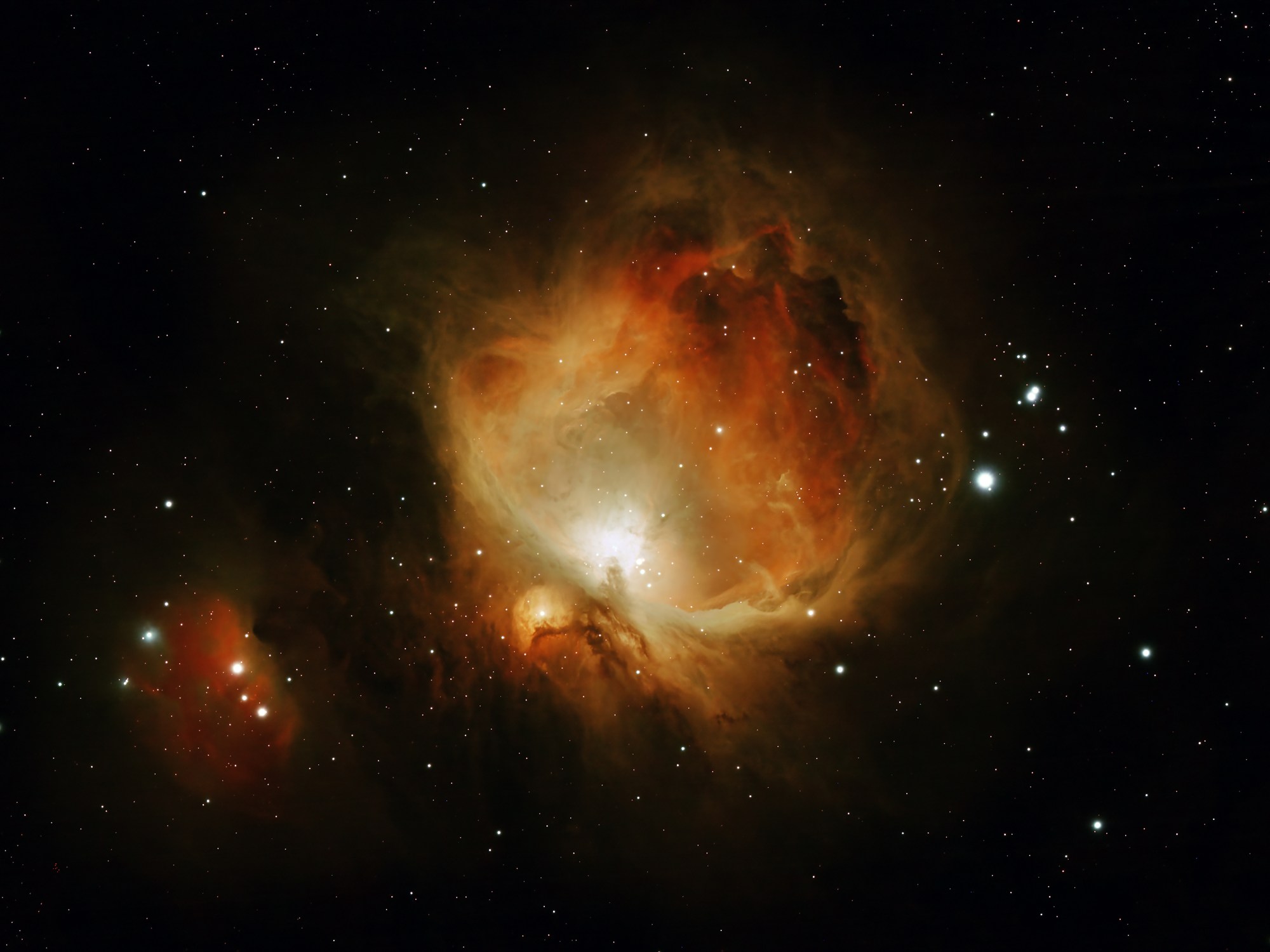
Here’s an image of Orion Nebula with around 2 hours of integration time.

Why does it matter?
The universe is a dark place. Faint objects like nebulae and galaxies emit only a trickle of light. By extending the integration time, your camera gathers more of this precious light, overcoming the darkness and revealing details invisible to the naked eye.
Here’s an image of Orion Nebula with 4.5 hours of integration time. You can clearly see more detail in the core of the Nebula, it is not so washed out. This is due to the image needing to be processed, or stretched, less. The outer dust and gas clouds of the Nebula have more detail, are less grainy and noisy, appearing more smooth.

In addition to integration time, how the image is handled in processing can have an impact. Subtle changes such as decreasing the saturation as in the image below tone down the colors to something more natural. The lower saturation also allows more of the tonal range to show through. Which do you prefer? The more saturated colorful image, or the slightly less saturated below?

Think of it like a bucket:
Imagine the light from a faint object filling a bucket. A short exposure time gives you only a few drops. But with longer integration, the bucket slowly fills, revealing the true depth and beauty of the object.
The benefits of long integration:
- Reduced noise: The bane of any astrophotographer, noise appears as unwanted specks in the image. Longer integration allows you to average out this noise, resulting in a smoother, cleaner image.
- Deeper details: By collecting more light, you reveal features and structures previously hidden in the darkness.Faint dust lanes, delicate nebula tendrils, and the subtle color variations of galaxies all come to life with increased integration time.
- Capturing dimmer objects: With longer exposures, you can reach fainter objects that lie beyond the grasp of shorter integrations. This opens up a whole new realm of possibilities for exploring the cosmos.
If we zoom in on the same area of the image you can clearly see the difference between 2 and 4.5 hours of integration time. The image on the right (2.5 hours) has more noise and less fine details in the outer gas/dust cloud.

The trade-off:
Of course, longer integration comes with its own challenges. Tracking errors from Earth’s rotation can blur the image, and light pollution can add unwanted background glow. Additionally, patience is key, as you might be staring at the same patch of sky for hours on end.
Finding the sweet spot:
The ideal integration time depends on several factors, like the target object’s brightness, your equipment, and the sky conditions. Experimenting and learning from other astrophotographers is crucial to finding the perfect balance between capturing enough light and maintaining sharp details.
So, the next time you point your camera at the stars, remember the magic of integration time. It’s the key to unlocking the hidden secrets of the universe, one photon at a time.
Discover more from Nicks Astrophotography
Subscribe to get the latest posts sent to your email.
 Nicks Astrophotography