
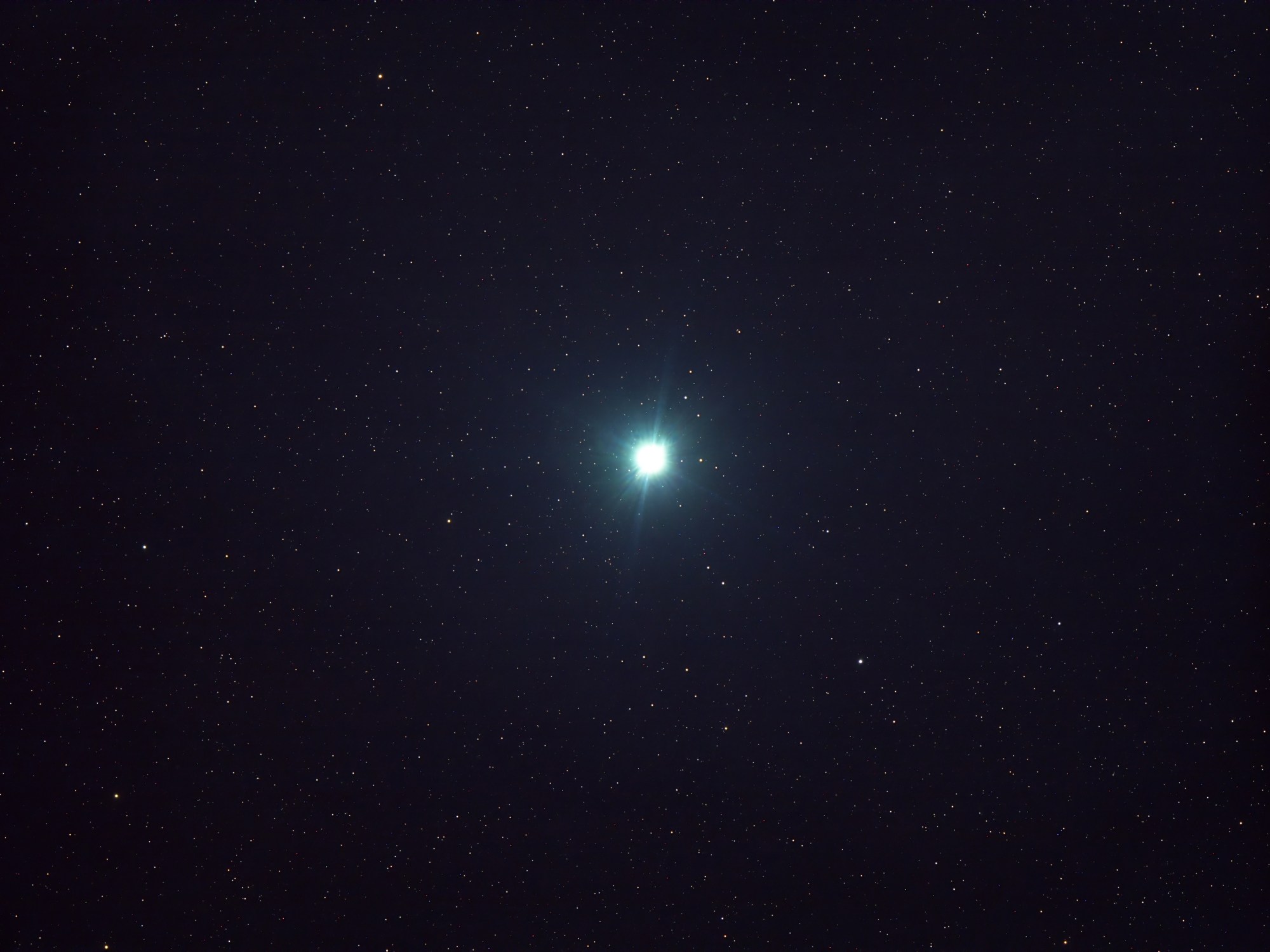
Gazing up at the night sky, one star consistently outshines the rest. This celestial beacon, known as Sirius or the Dog Star, reigns supreme as the brightest star visible from Earth, excluding planets, our moon, and the occasional bright comet.
Sirius holds a place of prominence not only in our night sky but also in various cultures and mythologies. Its name, derived from the Greek word “Seirios,” meaning “glowing” or “scorching,” aptly describes its brilliance. Ancient Egyptians held Sirius in high regard, associating it with the annual flooding of the Nile River and linking it to their deities.
But what makes Sirius so bright? Unlike our sun, which is a yellow dwarf, Sirius is a blue-white main-sequence star, burning hotter and radiating considerably more light. Its surface temperature, reaching almost 10,000 Kelvin, surpasses our sun’s by over 4,000 Kelvin. However, its distance, roughly 8.6 light-years away, keeps it from scorching Earth.

Despite its singular appearance, Sirius isn’t alone. It’s actually part of a binary star system, where a smaller, fainter white dwarf companion, Sirius B, orbits the primary star. This intriguing pairing, with a combined age estimated at around 200 million years, offers astronomers a valuable window into the complexities of stellar evolution.
Studying Sirius allows scientists to delve into the lives of massive stars and their potential impact on their surroundings. The intense radiation and stellar winds from Sirius are believed to influence the surrounding interstellar medium, potentially triggering star formation in nearby clouds.
So, the next time you find yourself gazing at the night sky, take a moment to locate Sirius. This brilliant star, with its rich history, captivating companion, and ongoing scientific significance, serves as a constant reminder of the wonders that lie beyond our own world.
Discover more from Nicks Astrophotography
Subscribe to get the latest posts sent to your email.
 Nicks Astrophotography