
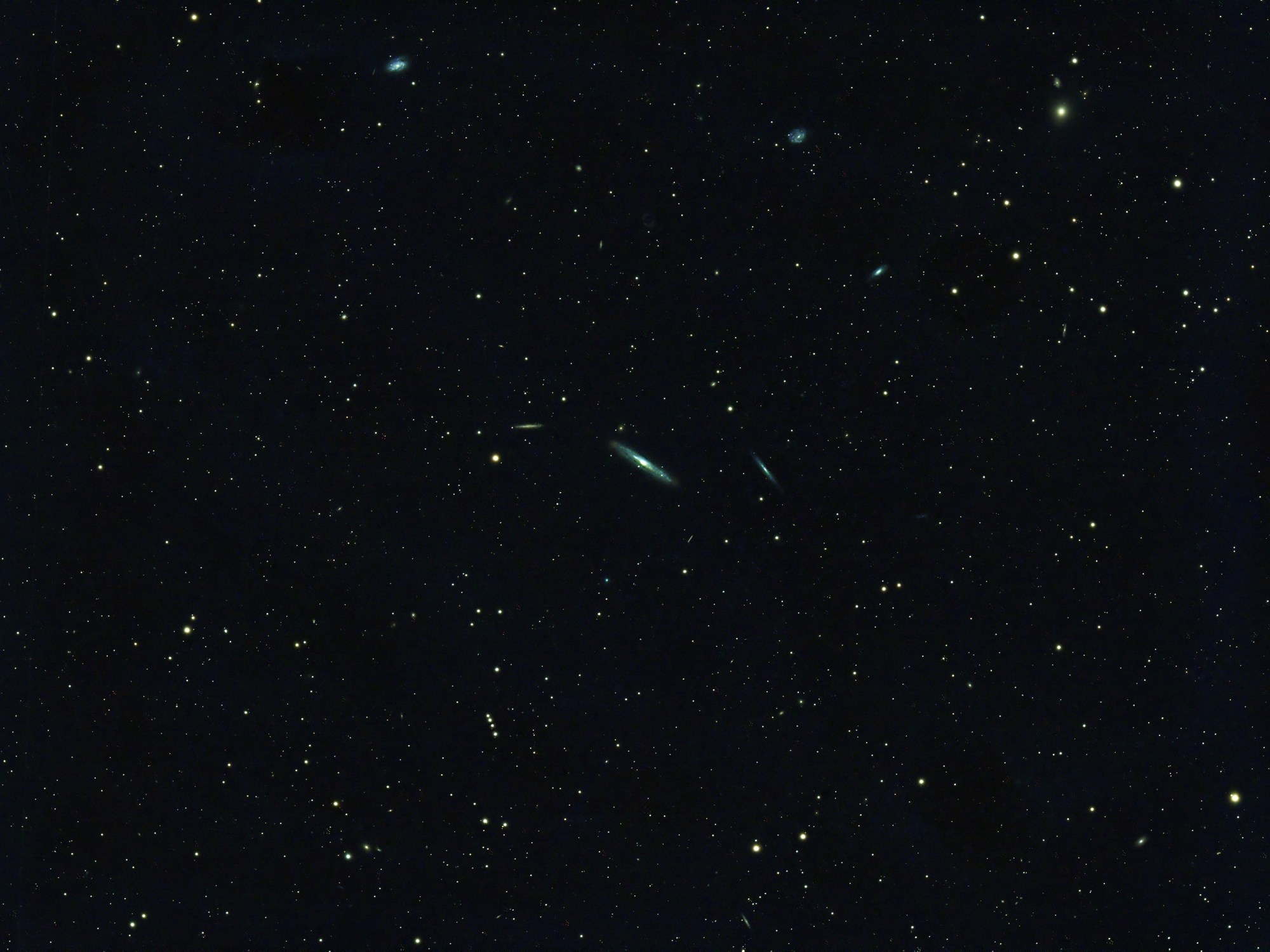
Soaring through the constellation Virgo, the Silver Streak Galaxy, also known as NGC 4216, offers a captivating glimpse into a galaxy viewed from the side. Unlike the majestic spiral arms of galaxies like our Milky Way, the Silver Streak presents itself as a slender streak of light, earning its descriptive nickname.
With a distance of approximately 55 million light-years from Earth, NGC 4216 holds the distinction of being the brightest of three edge-on galaxies residing in its celestial neighborhood. Despite its elongated appearance, astronomers classify it as a SABb spiral galaxy, indicating a loosely wound structure with a central bar and prominent dust lanes.
Gazing upon the Silver Streak through telescopes, one can appreciate its elongated form, stretching roughly eight times its width. However, its true size is far more impressive. While appearing slender, the galaxy measures approximately 91,000 light-years across, comparable to the diameter of our own Milky Way.

The edge-on orientation provides unique insights for astronomers. By studying the distribution of stars and dust within the galaxy’s disk, they can gain valuable information about its structure, rotation, and ongoing star formation processes.
In January 2024 a Supernova was discovered in the Silver Streak Galaxy. I’m a little late to capture this. The Supernova was at its height in mid January 2024, it is now the start of March.

The Silver Streak isn’t alone in its celestial journey. It resides within a cluster of galaxies known as the Virgo Cluster, home to thousands of galaxies locked in a gravitational dance. This close proximity may play a role in the galaxy’s evolution, potentially triggering star formation or influencing its overall structure.
For amateur astronomers, the Silver Streak presents a challenge. Due to its faintness, requiring a magnitude of around 10.3 to be visible, observing it necessitates dark skies and powerful telescopes. However, for those with the right equipment and dedication, the Silver Streak offers a rewarding glimpse into the diverse and captivating structures that populate our universe.
Discover more from Nicks Astrophotography
Subscribe to get the latest posts sent to your email.
 Nicks Astrophotography