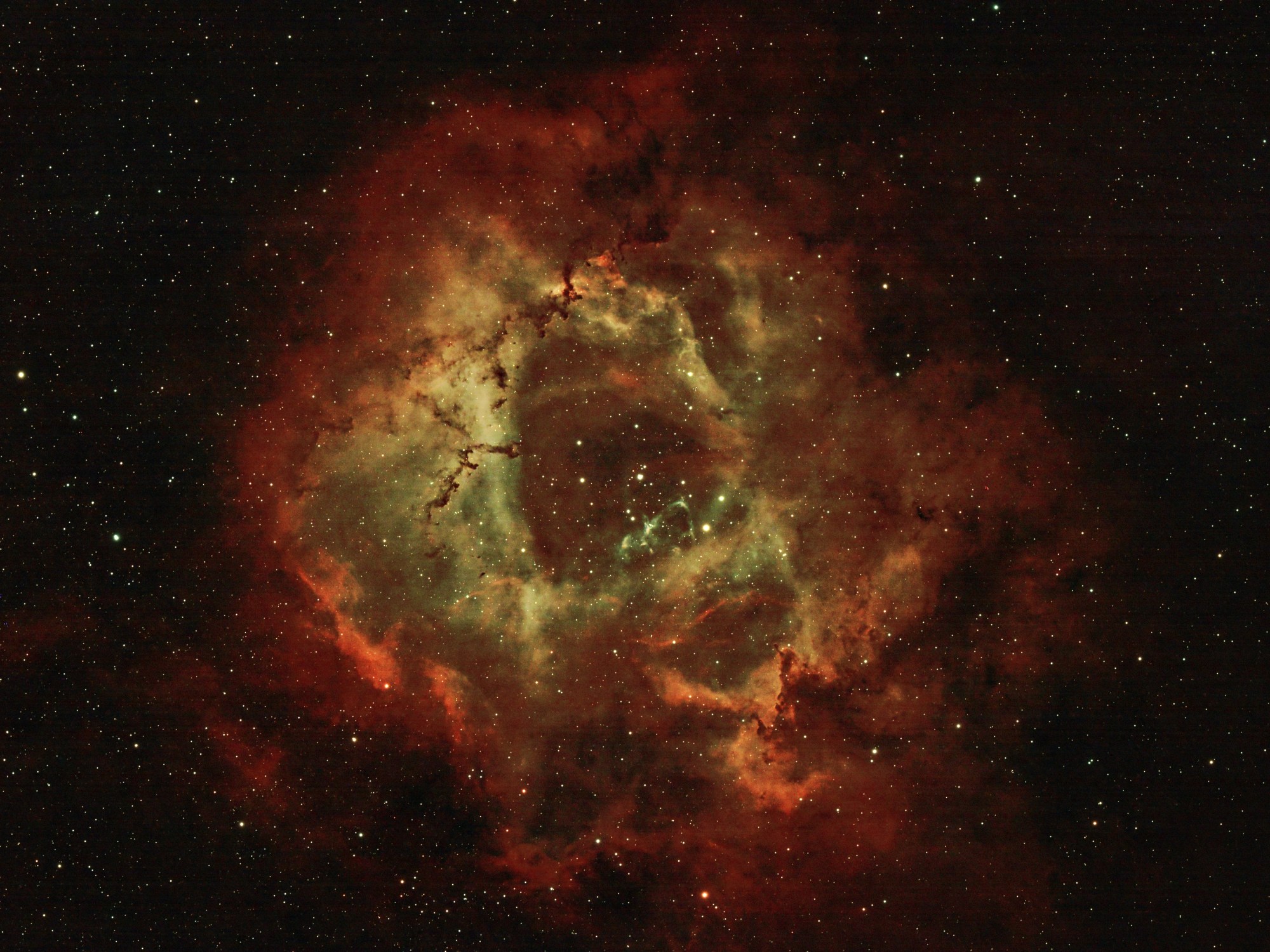
The Rosette Nebula is one of my favorite targets to shoot. It is often visible high in the sky from my vantage point, for some reason even when cloudy it seems to always be the one in the gap in the clouds.
It’s bright and so doesn’t need too many hours of exposure time. Also, when I switch to monochrome camera it’s a great narrowband target to start practicing on.
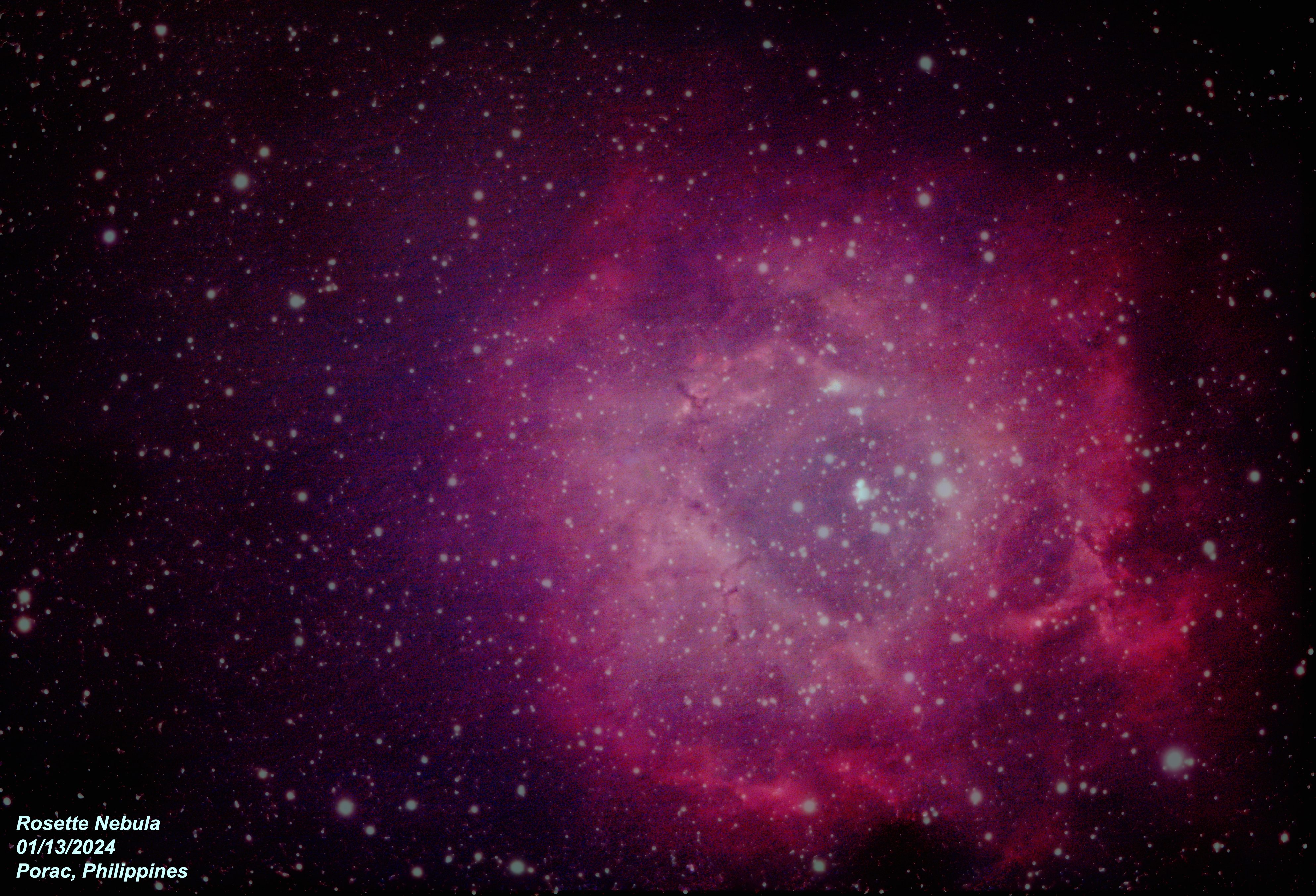
The Rosette Nebula was one of the first targets I shot back in January 2024. At the time I really didn’t know what I was doing, how to get properly focused, I wasn’t auto guiding, and my post processing skills in Photoshop and Pixinsight needed a lot more refinement.
On saying that, my first image of the Rosette Nebula, at the time, made me extremely proud. I was able too find the, get the scope aligned, all my equipment was “talking” to each other and my computer (except auto guiding). Here was the result of that first image.
By February of 2024 I was gaining more skills both in post processing and editing. I had learned how to properly focus the scope, and I was able to start auto guiding. Although my exposures were limited to sub 3 minutes, as I started to get elliptical stars much after 180 seconds even with auto guiding. However, it was an improvement to say the least. I had also started using Pixinsight for some editing but was finishing things off in Photoshop still. For stacking I used Deep Sky Stacker.
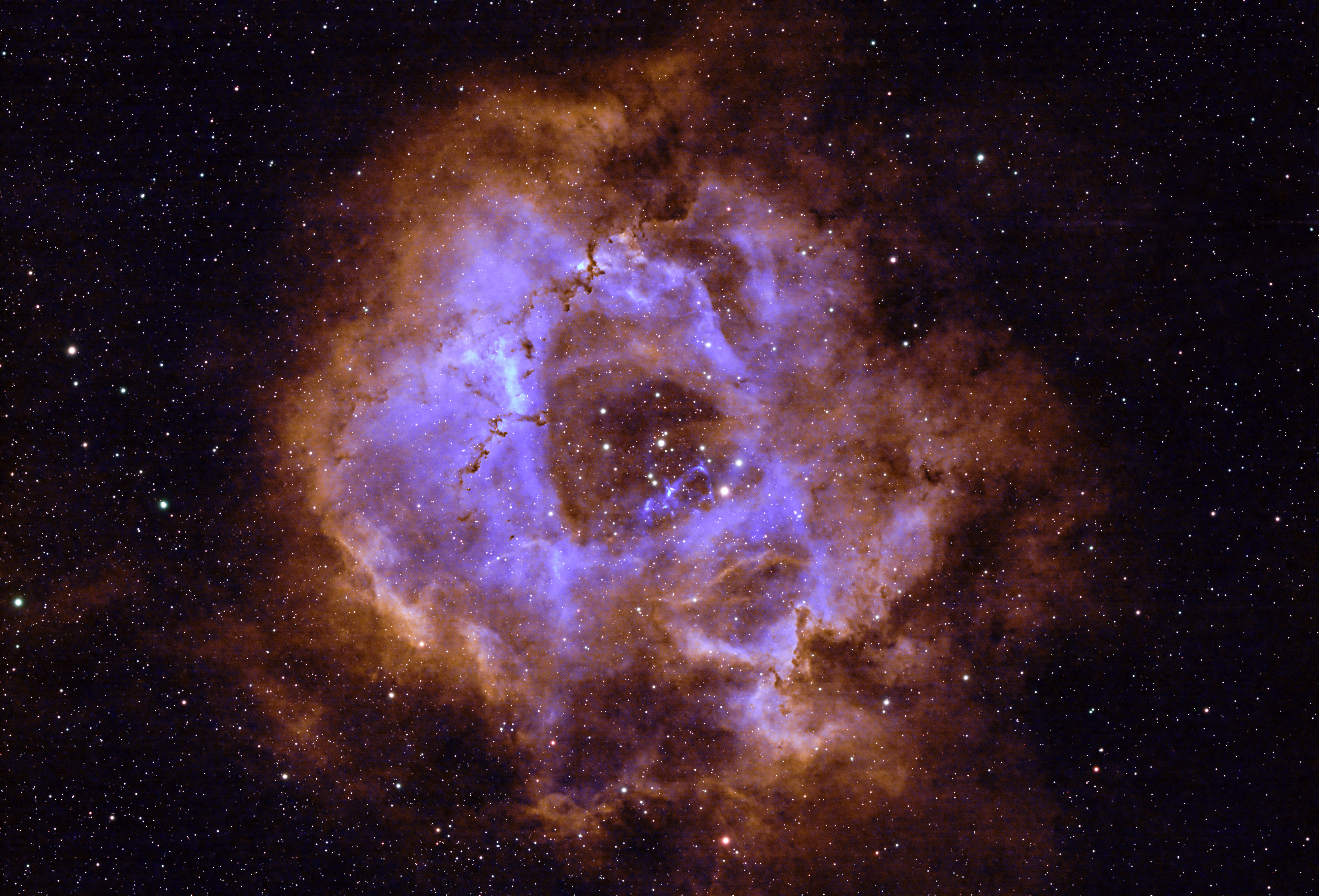
You can see a marked improvement from my first image! This one was also processed to apply a false color palette known as the Hubble Palette.
Finally that brings us to March 2024. I wanted to test how well my auto guiding was working as I had spent the past week fine tuning some of those settings. I went for 5 minute exposures. It was cloudy so I only had 45 minutes total time on target.
Stacking and processing was completely done in Pixinisight, using the weighted batch pre processing script, which applies a weighting to the individual frames based on their quality. This decides how much influence that frame has on the final output.
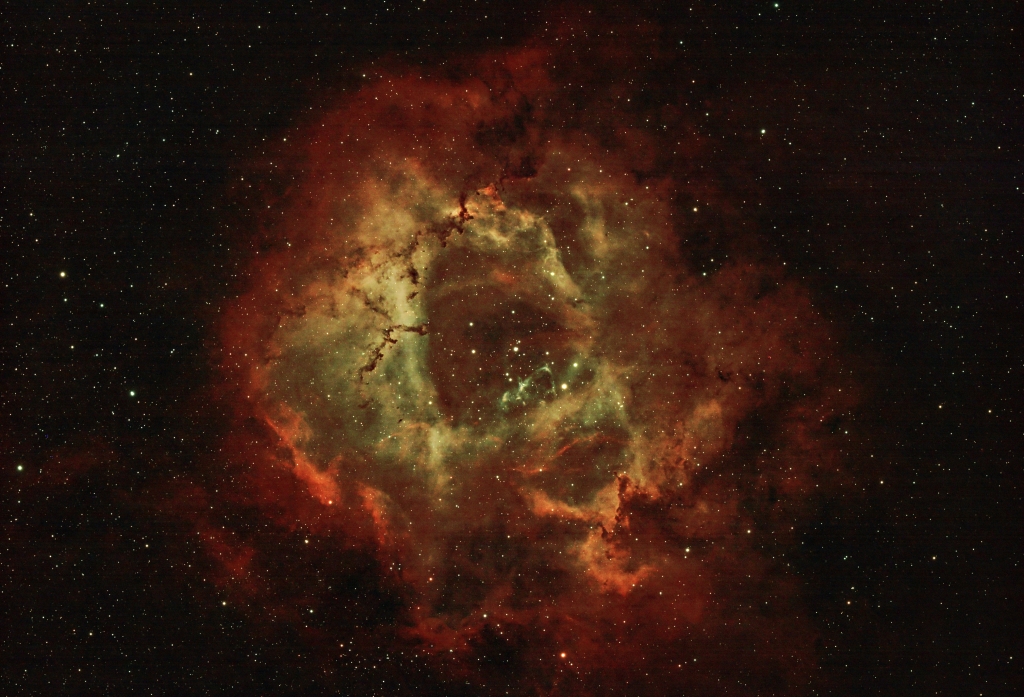
Not a massive difference to February, but as with most skills progress will not be linear, it will. be a curve. The most improvements come rapidly at the start, as you get better then improvements start to come at smaller increments. Is this March image better than February? Not necessarily, although keep in mind the above image was captured with only 45 minutes of data, and I believe I can improve this further with some more exposure time. However, when you consider my goal here was to determine how much better my auto guiding was, this is a great success. These are 5 minute exposures, and the stars are quite sharp, which indicates my auto guiding was within sufficient accuracy for 5 minutes of exposure time. So measured by this, I would declare this a success. Next clear sky I will continued with at least another 45 minutes of data on this target, and possibly add a further 45 minutes after that using a dual pass filter to highlight those Ha regions.
Discover more from Nicks Astrophotography
Subscribe to get the latest posts sent to your email.
 Nicks Astrophotography