

Messier 90 (M90), a majestic spiral galaxy, resides roughly 60 million light-years away in the constellation Virgo. Classified as an intermediate spiral galaxy, M90 boasts tightly wound spiral arms and a hint of a central ring structure. It was discovered by astronomer Charles Messier in 1781 while studying the Virgo Cluster, a collection of thousands of galaxies.
M90 holds a distinction within the Virgo Cluster. Unlike most galaxies, which are moving away from us due to the expansion of the universe, M90 is one of the few approaching our Milky Way galaxy. This unique motion suggests it may be speeding through the cluster at an exceptional velocity, possibly even escaping its grasp.
Despite its large size, M90 is thought to be a relatively low-density galaxy. This is because the environment within the Virgo Cluster has stripped away much of its interstellar medium, the gas and dust needed for star formation. However, deep within its core, a burst of star formation persists. M90 is estimated to harbor a trillion stars and a staggering 1,000 globular clusters, spherical collections of ancient stars.
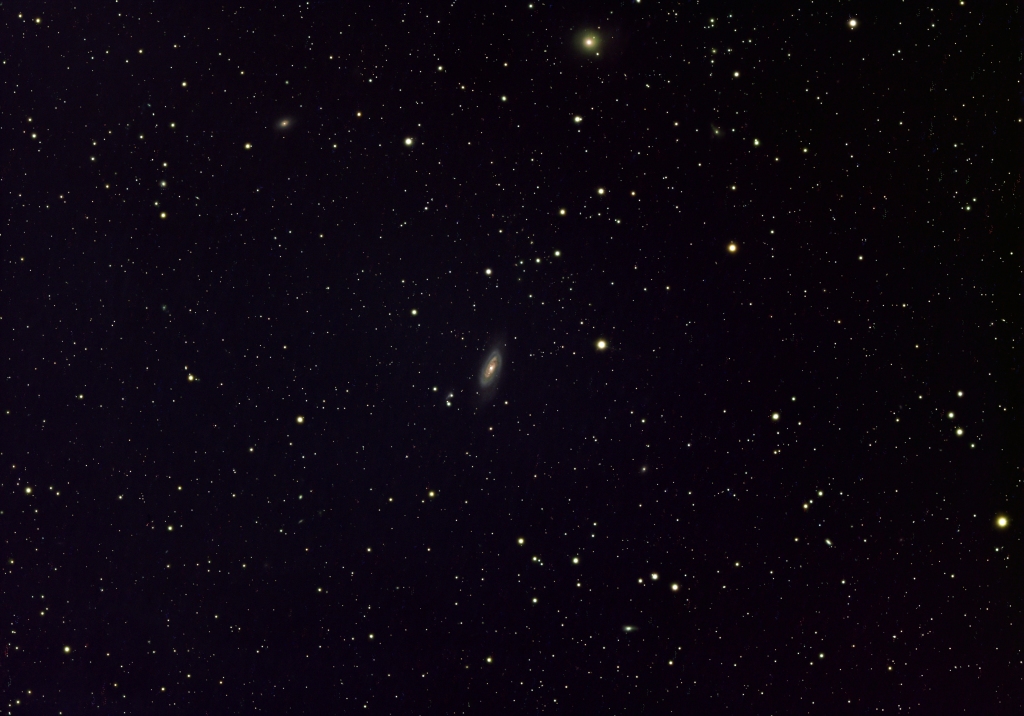
The above image is 3 hours of data, with 300 second exposures through an 80mm apochromatic refractor scope. Tracking on an AM5 mount with autoguiding from PHD2. Below is the cropped verison of this image.
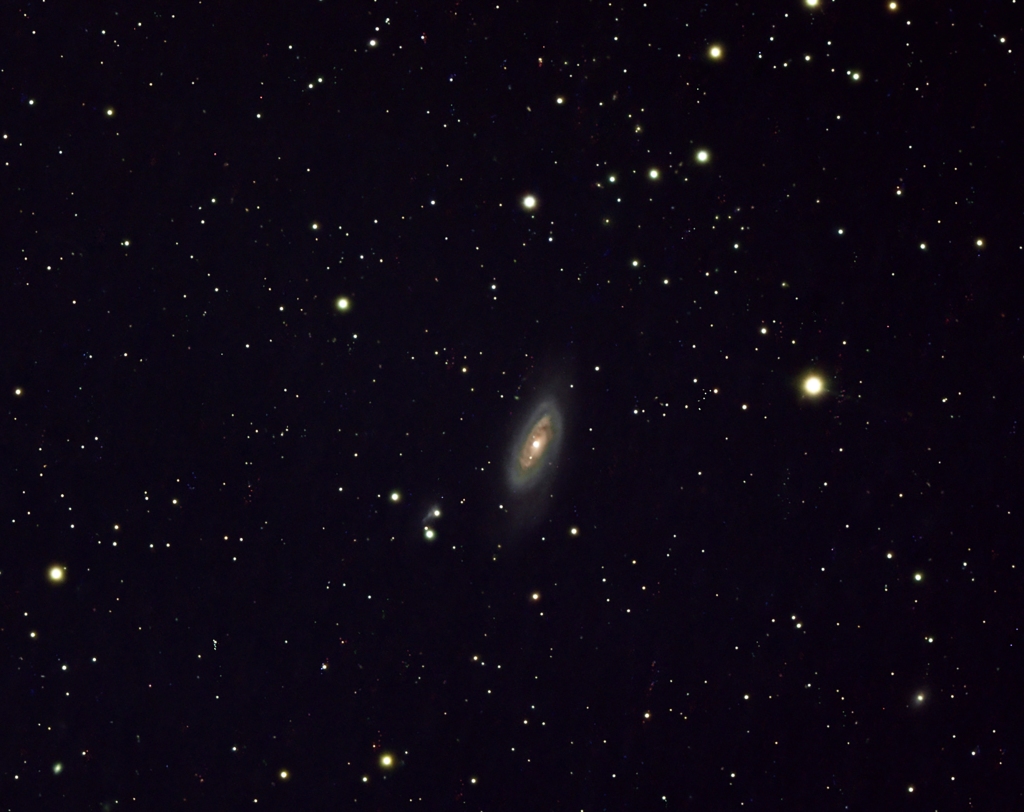
If you’re an avid stargazer with powerful binoculars under exceptionally clear skies, you might be able to catch a glimpse of M90 as a faint, oval-shaped patch of light. For a more detailed view, telescopes are necessary, revealing the galaxy’s beautiful spiral structure. M90 continues to be a fascinating subject of study, offering insights into galactic dynamics and the evolution of galaxies within dense environments like the Virgo Cluster.
Discover more from Nicks Astrophotography
Subscribe to get the latest posts sent to your email.
 Nicks Astrophotography