
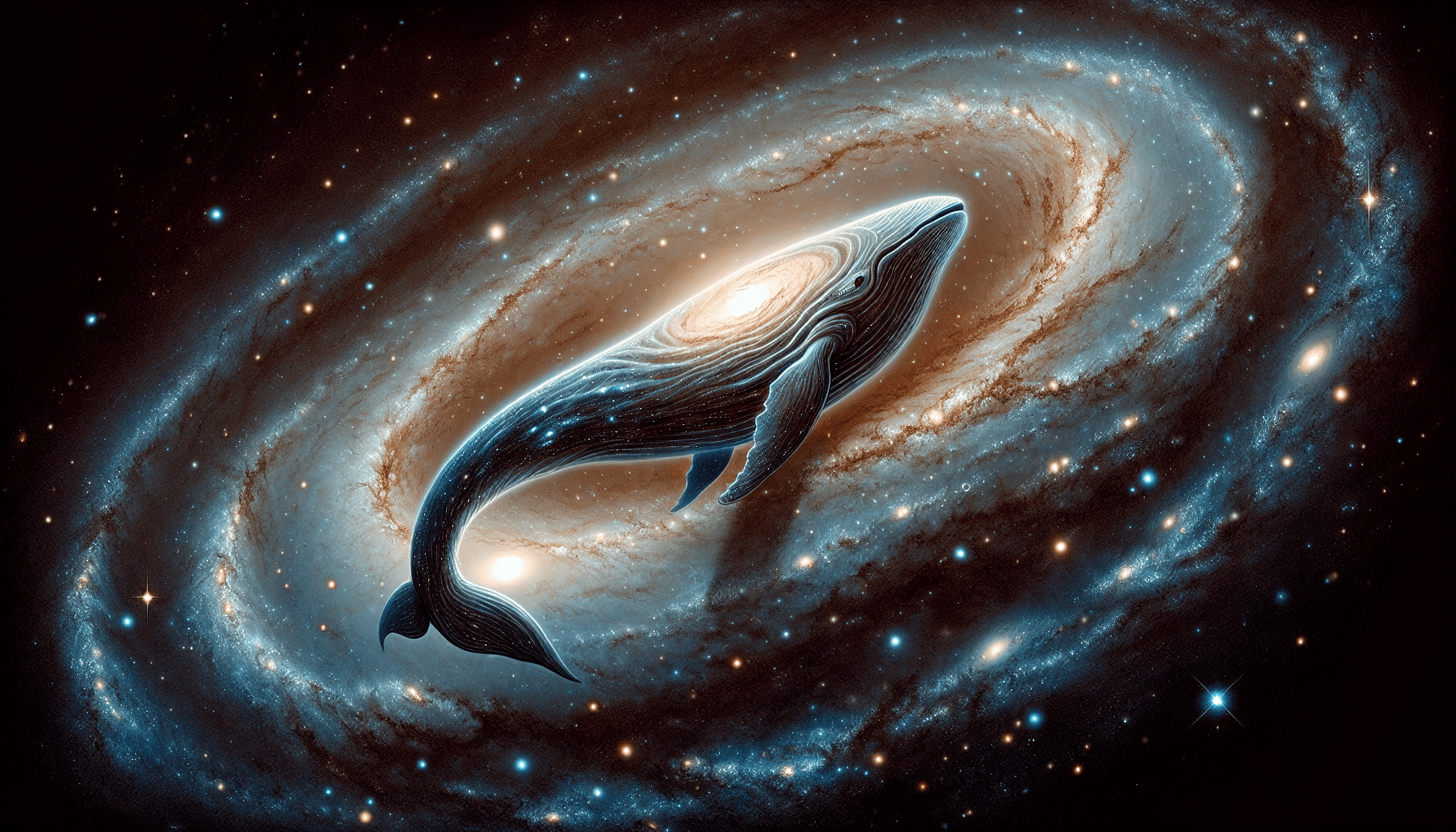
Gazing into the depths of the universe, astronomers have spotted a majestic resident – the Whale Galaxy. Nicknamed for its elongated shape resembling the aquatic mammal, this galactic giant is a barred spiral galaxy roughly 30 million light-years away in the constellation Canes Venatici.
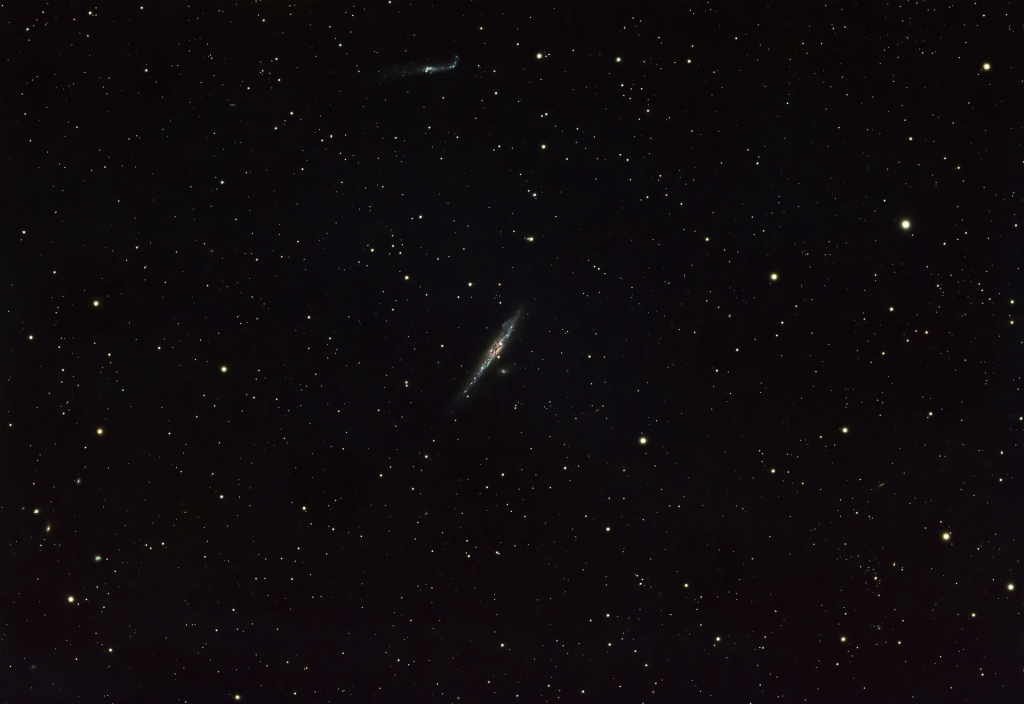
Unlike our own Milky Way, which we view face-on, the Whale Galaxy presents itself sideways to Earth. This unique perspective allows scientists to peer into the swirling disk of stars and gas that forms its body. The galaxy’s center, a hotbed of star formation, is silhouetted against the dark dust lanes that course through its disc.
The Whale Galaxy is a busy place. It’s classified as a barred spiral, meaning it has a central bar-shaped structure from which its spiral arms extend. These arms are brimming with star-birthing clouds, evident by the pockets of bright blue young stars that illuminate the galaxy’s visage.
Interestingly, the Whale Galaxy isn’t alone. It has a smaller companion, the dwarf elliptical galaxy NGC 4627, often referred to as the Pup Galaxy. These two cosmic neighbors are thought to be gravitationally interacting, a dance that may influence their future evolution.
Studying the Whale Galaxy provides valuable insights for astronomers. Its edge-on view allows them to understand the distribution of gas and stars outside the plane of a spiral galaxy. Additionally, observations of the Whale Galaxy have revealed the presence of a superwind, a powerful outflow of gas blasting out from the galaxy’s center.
While not visible to the naked eye, the Whale Galaxy is a fascinating target for astrophotographers using telescopes. Its majestic form and the ongoing stellar drama within its depths make it a captivating window into the wonders of the cosmos.
Discover more from Nicks Astrophotography
Subscribe to get the latest posts sent to your email.
 Nicks Astrophotography
One thought on “Unveiling the Whale Galaxy: A Stellar Giant Seen Sideways”