
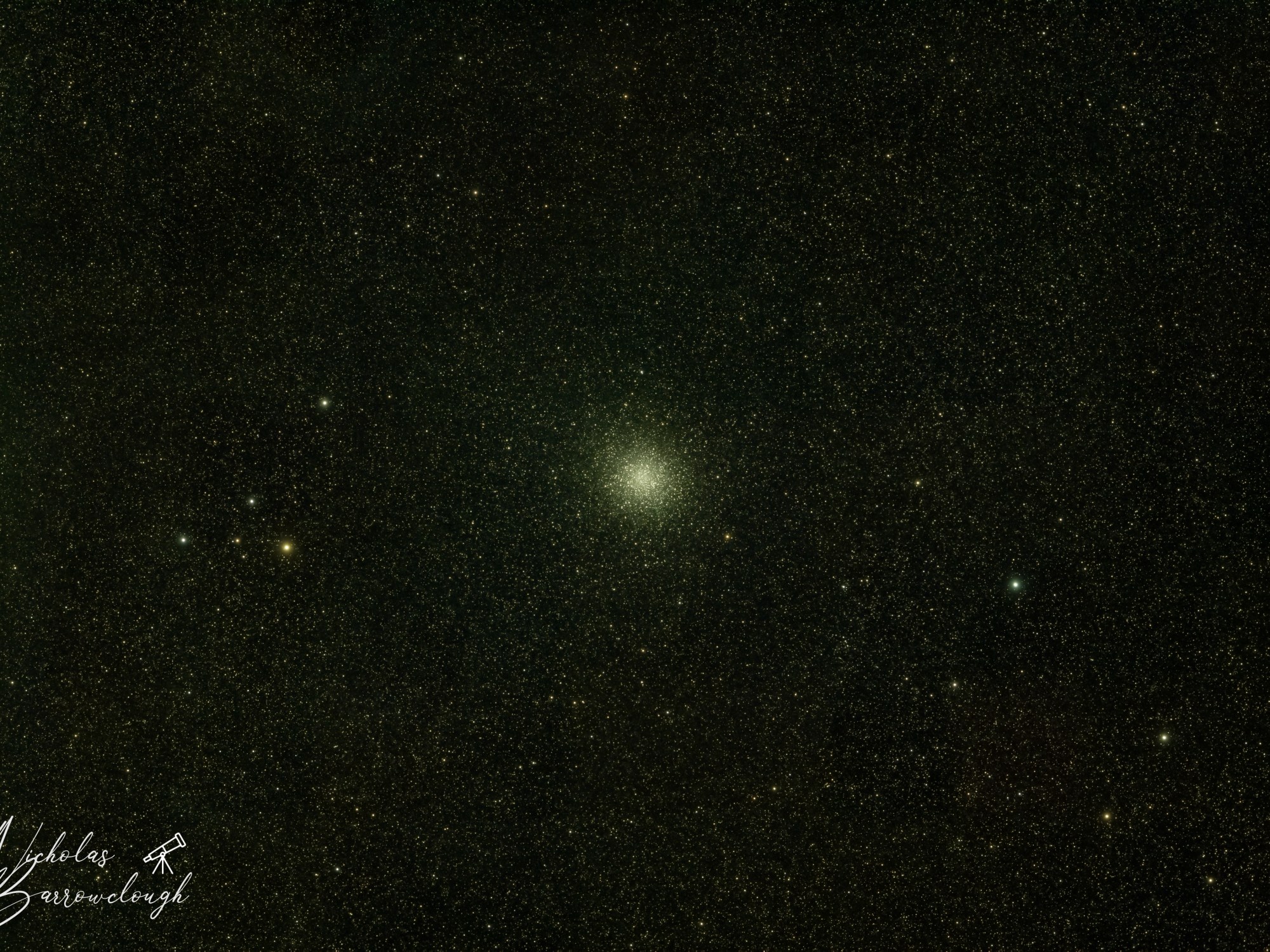
Messier 22 (M22) is also known as NGC 6656. It is called The Great Sagittarius Star Cluster. It is one of the brightest and closest globular star clusters to Earth. Located in the constellation Sagittarius, M22 is roughly 10,600 light-years away and spans about 70 light-years across. With an apparent magnitude of 5.1, it’s bright. You can see it with the naked eye under dark skies. This makes it a favorite for amateur astronomers.
M22 was one of the first globular clusters to be discovered. It was studied in detail and first cataloged by the French astronomer Charles Messier in 1764. This dense cluster contains around 200,000 stars, many of which are old, metal-poor stars over 12 billion years old. M22 is classified as an intermediate-metallicity globular cluster. This classification indicates that its stars are made of materials formed during the early universe. These materials formed long before our Sun and solar system came into existence.
The Below image was captured on the 9th November 2024 from my usual spot at home. It is 15 minutes of 30 second exposures through an SVBony 80mm Apochromatic triplet refractor and the SVBony 405cc one shot color camera.
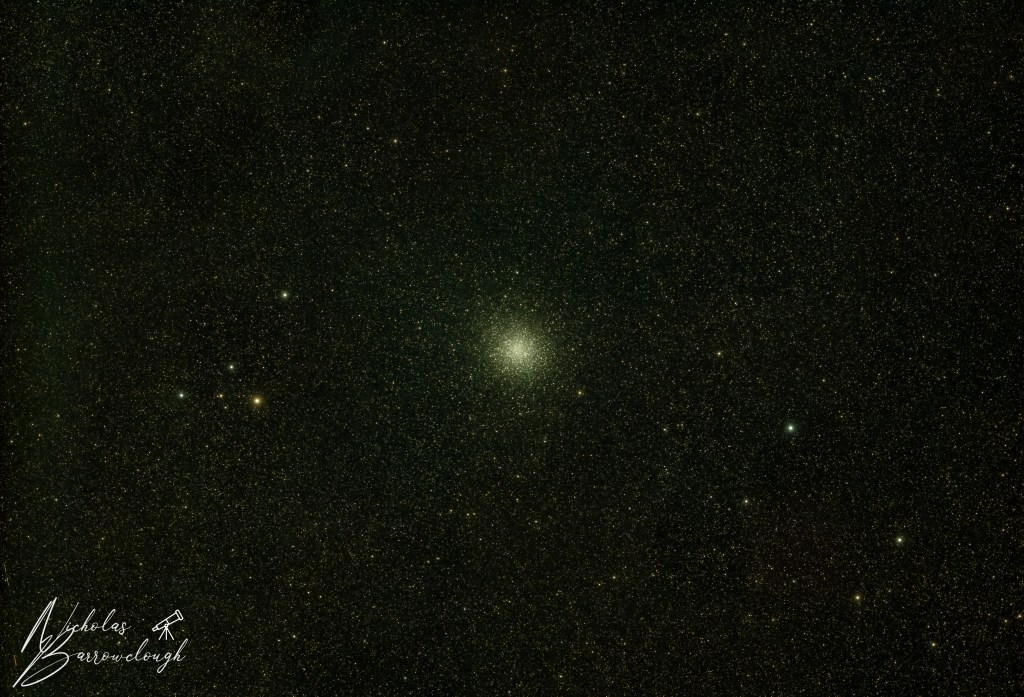
M22 has a high concentration of variable stars. It features many RR Lyrae stars, which are pulsating stars. These stars help astronomers measure distances in space. M22 is also known to host several planetary nebulae, a rarity for globular clusters. Observations with the Hubble Space Telescope have even hinted at the presence of small black holes within M22. These findings add to the cluster’s intrigue and significance in understanding the evolution of stellar populations.
Positioned against the rich backdrop of the Milky Way’s center, M22 is easy to find in the night sky. It lies near the “Teapot” asterism in Sagittarius. This makes it a striking and accessible target for stargazers. It is also a key object of study for scientists exploring the history of our galaxy.
Discover more from Nicks Astrophotography
Subscribe to get the latest posts sent to your email.
 Nicks Astrophotography
One thought on “M22: A Guide to the Brightest Globular Star Cluster”