
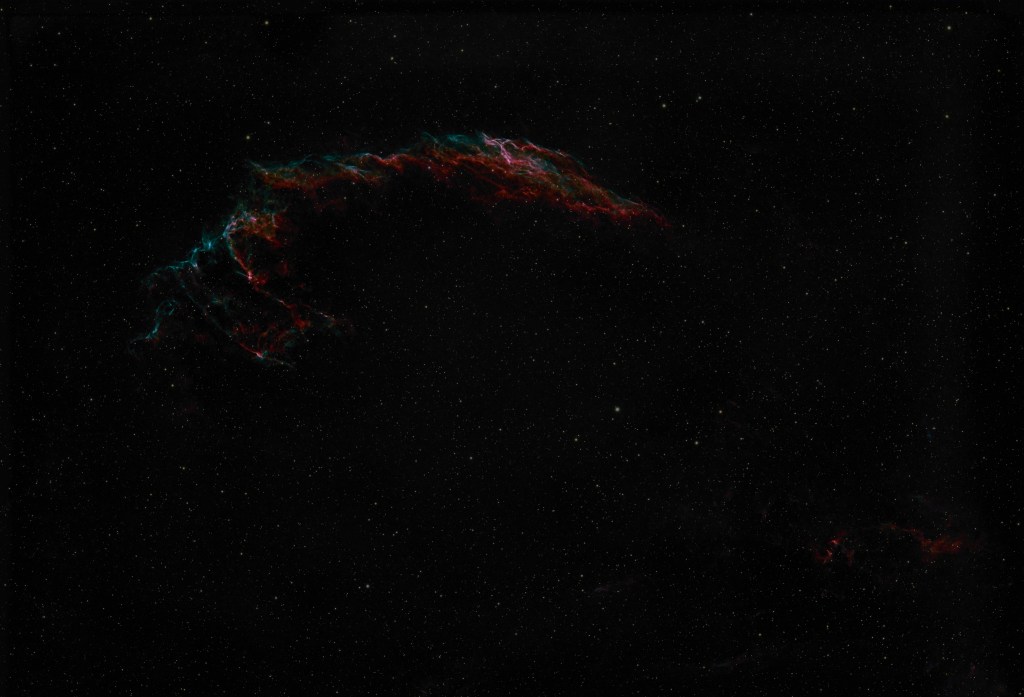
The East Veil Nebula is part of the larger Veil Nebula. It is a radiant and spectacular remnant of a supernova explosion. This event occurred approximately 10,000 to 20,000 years ago. This nebula is located about 2,400 light-years away in the constellation Cygnus. It offers astronomers and stargazers a striking view of the aftermath of a massive star’s death.
The Veil Nebula spans an impressive 110 light-years. It is divided into distinct segments. The East Veil Nebula is one of its most well-known portions. Also known as NGC 6992 and NGC 6995, this region displays luminous and flowing arcs of gas. These arcs shine in a dazzling array of colors. These colors correspond to different elements. For example, hydrogen is red, oxygen is blue-green, and sulfur is red or orange. The shockwaves from the supernova energize these elements.
The East Veil Nebula is celebrated not only for its scientific significance but also for its breathtaking beauty. It is a popular target for both amateur and professional astrophotographers. They often capture its intricate filaments and vivid hues with long-exposure imaging. These images reveal the nebula’s structure in exquisite detail. They showcase the complexity of the interstellar medium as it interacts with powerful cosmic forces.
You need a telescope and dark skies to observe the East Veil Nebula. Its faint glow is not visible to the naked eye. Through telescopes, its wispy tendrils and glowing edges create an otherworldly visual. This sight sparks curiosity and wonder about the life cycle of stars. It also reveals the dynamic processes shaping our galaxy.
The East Veil Nebula shows us the transformative nature of the universe. The violent end of one star can create stunning celestial phenomena. It enriches the cosmos with elements. These elements may one day form new stars, planets, and perhaps even life.
This image is my initial 1.5 hours of data through a 80mm apochromatic 480mm focal length scope. Imaged with a one shot color camera. Processed with Pixinsight and Photoshop.
Each exposure was 240 seconds long.
The below is a total of 3 hours data. More details in the fainter areas are starting to show. I also extended the exposure time to 300 seconds for the additional frames.

Discover more from Nicks Astrophotography
Subscribe to get the latest posts sent to your email.
 Nicks Astrophotography