

The Witch Head Nebula is officially designated IC 2118. It is a striking reflection nebula. It is located approximately 900 light-years away in the constellation Eridanus. Its eerie and ghostly appearance has earned it the nickname “Witch Head.” It resembles the profile of a witch’s face in silhouette.
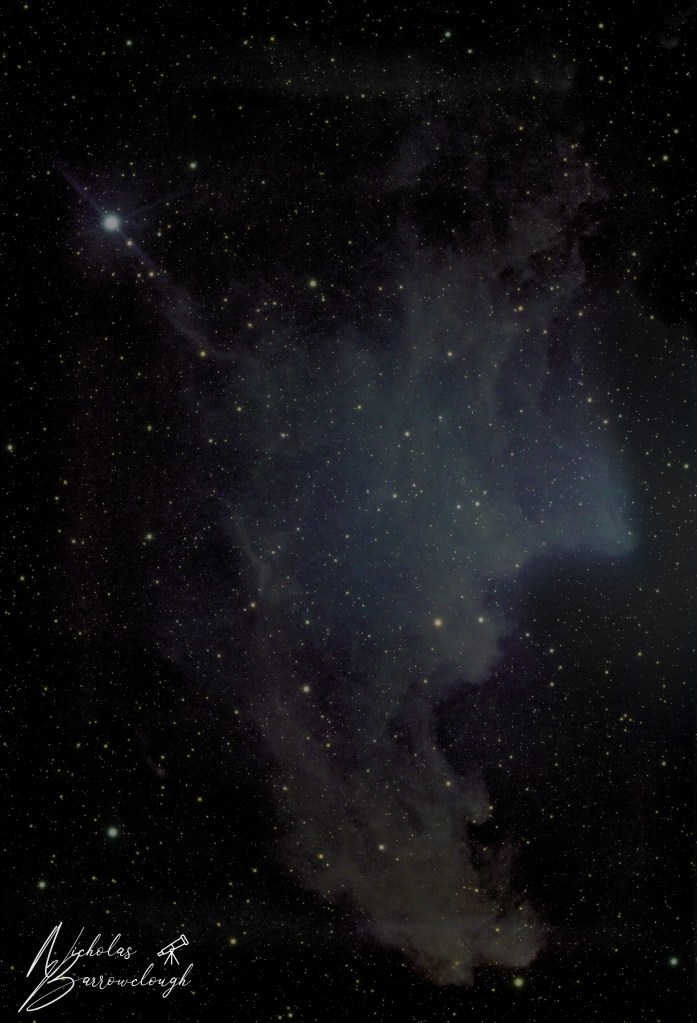
The above image is composed of 4 hours of data collected over multiple nights. 300 second exposures were used through an 80mm f6.5 SVBony apochromatic triplet refractor. A UV/IR filter was used to reduce star bloat. A one shot color camera (SVBony 405cc) was used to capture the image.
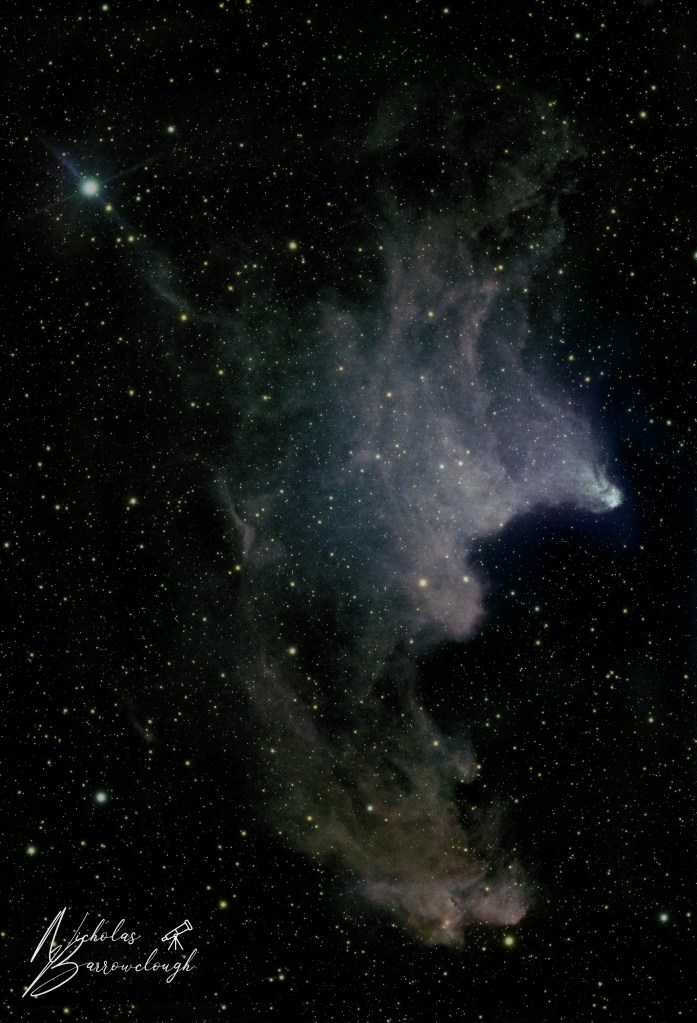
The above image is an additional 3 hours of data, for a total of 6 hours exposure.
This nebula is illuminated by the nearby supergiant star Rigel, part of the constellation Orion. The light from Rigel reflects off the dust particles in the nebula, creating its characteristic bluish hue. The blue color occurs due to the scattering of shorter wavelengths of light. This is akin to why Earth’s sky appears blue.
IC 2118 is composed primarily of interstellar dust and gas, stretching over 50 light-years in size. It is a region of low star formation activity, making it a relatively quiet area of the cosmos. Still, its intricate structure and spectral glow make it a favorite target for astrophotographers and astronomers alike.
The Witch Head Nebula serves as a reminder of the beauty and diversity of the universe. It showcases how light and matter interact to create mesmerizing celestial art. Whether viewed through a telescope or captured in detailed images, it continues to enchant stargazers with its haunting charm.
Discover more from Nicks Astrophotography
Subscribe to get the latest posts sent to your email.
 Nicks Astrophotography