
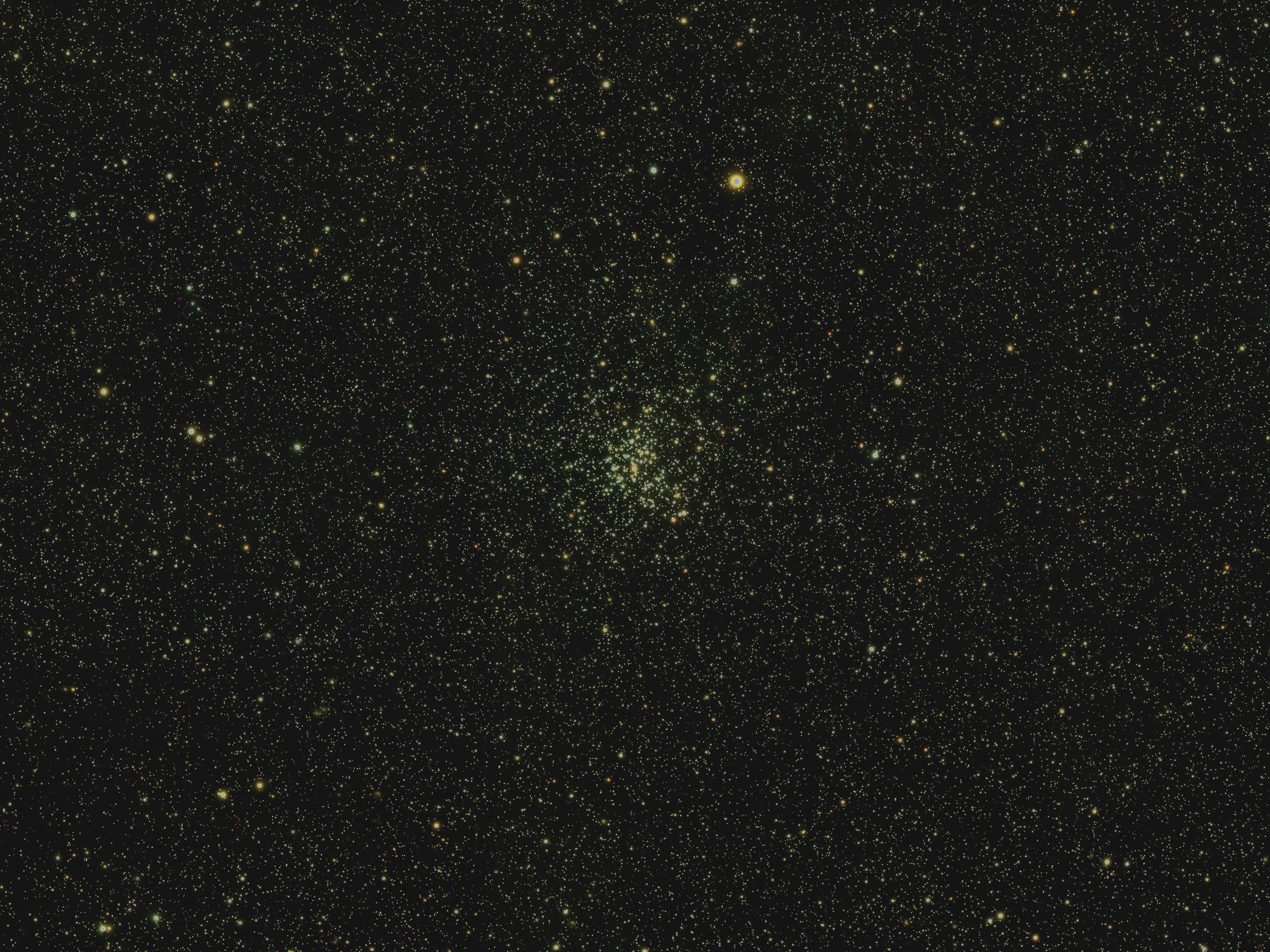
The night sky holds countless wonders, and the M37 open cluster is no exception. Nicknamed the “Salt and Pepper Cluster”, M37 is a dazzling collection of stars nestled within the constellation Auriga, the Charioteer.
M37 is estimated to be roughly 2.4 billion years old, making it a relatively young cluster compared to some in our galaxy. It boasts hundreds, if not thousands, of stars, primarily hot, blue-white main sequence stars. These young stars bathe the cluster in a brilliant glow, making it visible to the naked eye under dark skies.
M37 appears as a hazy patch of light to the naked eye, but binoculars or a small telescope reveal its true beauty. Through magnification, the cluster transforms into a sparkling jewel box, with countless stars twinkling against the backdrop of space.
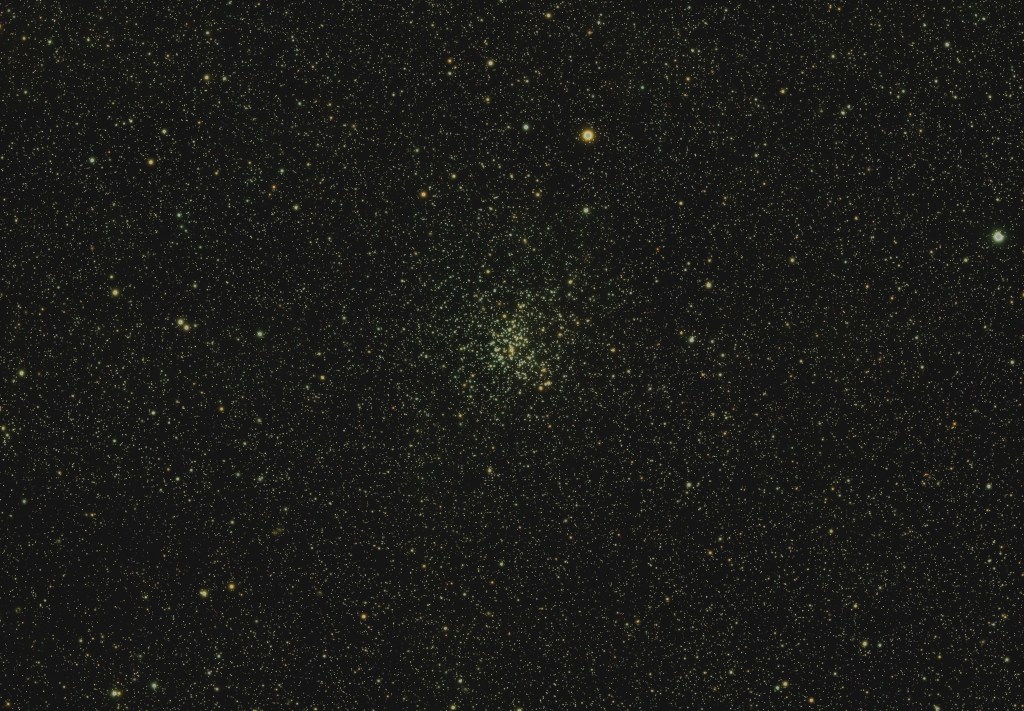
The above image is captured through an 80mm apochromatic triplet refractor telescope. a combination of 1 hours 60 second exposures and 30 minutes 120 second exposures. Tracked on an AM5 mount and shot with a color astrocamera from SVBony (SV405cc) cooled to 5°C with a gain of 110.

Here is a cropped version of the previous image, where you get a closer view of the cluster, and the large star at it’s center.
A Stellar Nursery
The stars within M37 are thought to have formed from the same giant molecular cloud billions of years ago. This shared origin and close proximity create a fascinating environment for astronomers to study. By observing the variations in brightness, color, and mass among the cluster’s stars, astronomers can gain valuable insights into stellar evolution.
The tight gravitational pull within M37 also plays a role in its evolution. As stars within the cluster interact with each other, they can be flung out into the vast expanse of the Milky Way galaxy. Over time, this process will gradually disperse the cluster, leaving behind a trail of lone stars as a testament to their shared past.
A Celestial Beacon
M37 is not only a beautiful sight but also a valuable tool for astronomers. By measuring the motions of stars within the cluster, astronomers can determine its distance and overall mass. These measurements contribute to our understanding of the structure and dynamics of our Milky Way galaxy.
Finding the Rich Open Cluster
If you’re eager to witness the splendor of M37 for yourself, head out on a clear night and locate the constellation Auriga. M37 can be found near the bright star Capella, the constellation’s most prominent member. With a little stargazing know-how and a good pair of binoculars, you can unlock the secrets of this celestial jewel box and marvel at the glittering tapestry of stars within.
Discover more from Nicks Astrophotography
Subscribe to get the latest posts sent to your email.
 Nicks Astrophotography